Market Insights Blog

Real estate moves in cycles, but headlines rarely tell the full story.

This page breaks down what’s actually happening in the market, beyond surface-level commentary. You’ll find clear analysis on pricing trends, inventory levels, interest rate impact, buyer and seller behavior, and what the data is signaling right now.

Whether you're thinking about upsizing your home, buying as a First Time Home Buyer, selling, investing, or simply staying informed, understanding context is critical. Markets shift gradually before they shift dramatically. The goal here is to interpret patterns, not react to noise.

Each update is grounded with data insights, local activity, and real transactions, not speculation.

RSS

How to Invest in Toronto Condos in 2026: A Data-Driven Guide

Toronto’s condo market in 2026 is one of the most misunderstood opportunities in Canadian real estate.

Prices have corrected from peak 2022 levels. Investor sentiment is cautious. Immigration has slowed temporarily.

And yet, this is exactly where long-term opportunities are created.

If you’re thinking about investing in Toronto real estate, this guide will walk you through:

  • Why 2026 is a strategic entry point

  • Where to invest

  • What to watch for

  • How financing works (including for Canadians abroad)

  • Return on investment by the numbers

Real Estate vs Stock Investment

Let’s break it down by the numbers, Real estate vs. S&P 500 Stocks. I’ll walk you through a clear, data-backed view of your return on investment, using market insights and detailed calculation from hundreds of properties I’ve helped investors buy and sell over the years. No hidden gimmicks, just full transparency. 

Why 2026 Is a Strategic Entry Point

After years of aggressive growth, Toronto’s condo market has reset.

  • Prices are down from speculative peaks

  • Pre-construction pricing has disconnected from resale

  • Investor activity has slowed

But here’s what matters:

1. Supply Is Drying Up

Housing starts in Toronto have been at multi-year lows since 2024.

This is critical.

Because what gets built today determines supply in 2027–2029.

Fewer starts today = fewer units tomorrow.

2. Immigration Is Slowing But Not Stopping

Canada reduced immigration targets in 2025, which created short-term softness.

But:

  • Toronto still attracts 35–40% of newcomers

  • It remains the top economic hub in Canada

Demand may fluctuate but structurally, it’s still strong.

3. Long-Term Imbalance Is Building

When you combine:

  • Lower construction

  • Population growth

  • Urban job concentration

You get a likely supply shortage by 2027–2028 especially in central Toronto. This is where smart investors position early.

Where to Invest in Toronto

Not all condos are equal. Focus on neighbourhoods with:

  • Strong transit access

  • Lifestyle appeal

  • Long-term demand drivers

High-Conviction Areas:

  • Yorkville – premium, low supply, global appeal

  • King West – young professionals, high rental demand

  • Leslieville / Riverside – lifestyle + growth corridor

  • Distillery District / Canary District – master-planned + Ontario Line upside

  • Liberty Village – high rental liquidity

Also look near:

  • Future Ontario Line stations

  • Waterfront revitalization zones

  • Major employment nodes

What Makes a Good Condo Investment

In 2026, investing is no longer about speculation, it’s about fundamentals.

Look for:

  • Efficient layouts (no wasted space)

  • Functional 1+1 or 2-bedroom units

  • Reasonable maintenance fees

  • Strong building management

  • Rental-friendly buildings

Avoid:

  • Overpriced pre-construction

  • Poor layouts

  • Buildings with high investor turnover and weak management

The Numbers: Condo Pricing in 2026

Typical ranges:

  • 1-bedroom: $550K – $650K

  • 2-bedroom: $750K – $900K

Rental income:

  • 1-bedroom: $2,400 – $2,800/month

  • 2-bedroom: $3,200 – $3,800/month

This creates a more balanced environment where:

  • Cash flow may be tight

  • But long-term appreciation becomes the play

Step-by-Step: How to Invest in Toronto

1. Confirm Eligibility

To invest in Toronto real estate, you typically need:

  • Canadian citizenship or permanent residency

  • Or eligibility under current foreign buyer regulations

2. Build Your Financing Strategy

  • Understand your down payment capacity

  • Review mortgage options

  • Factor in closing costs and holding costs

3. Choose the Right Asset

Focus on:

  • Location

  • Layout

  • Building quality

Not hype.

4. Work With a Data-Driven Realtor

You want someone who:

  • Understands market cycles

  • Can analyze price per square foot

  • Identifies undervalued opportunities

5. Plan Your Exit Strategy

Before you buy, know:

  • Will you rent it?

  • Hold long-term?

  • Sell in 5–10 years?

Clarity upfront = better decisions.

Financing for Canadians Living Abroad (New York, London, Dubai, Kuwait, Saudi Arabia, etc.)

If you’re a Canadian citizen living and working abroad, you fall under non-resident mortgage programs.

Here’s what you need to know:

Down Payment Requirements

  • Minimum 35% down payment

  • No exceptions typically offered by major banks

Credit Requirements

  • Canadian credit history is still required

  • Lenders typically want:

    • At least 2 active trade lines

    • Minimum $3,000 combined limits

    • 2-year history

Additionally:

  • A foreign credit bureau report (e.g., from Dubai) must be provided

Income Verification

If employed, lenders will require:

  • 3–6 months of bank statements

  • Pay stubs to match deposits

  • Statements must be in English (or professionally translated)

Banking Requirements

  • You must open a Canadian bank account

  • Mortgage payments must be withdrawn from Canada

Important Limitations

  • No pre-approvals for non-residents

  • Lenders only review files once you have an accepted offer

Closing Requirements

  • You must be physically present in Canada to sign

  • Virtual signing from abroad is not permitted

Offer Strategy Tip

If buying resale:

  • Include a financing condition (minimum 5 business days)

  • This protects you while the lender reviews your file

The Reality of Investing in Toronto

Toronto is not a passive investment market.

It’s:

  • Competitive

  • Capital-intensive

  • Long-term focused

But it’s also:

  • One of the most resilient real estate markets in North America

  • A city driven by immigration, jobs, and global demand

Final Thoughts

2026 is not about chasing quick wins.

It’s about:

  • Entering at more reasonable price levels

  • Positioning ahead of future supply shortages

  • Investing with discipline

The investors who win in Toronto are the ones who:

  • Think long-term

  • Buy quality assets

  • Stay patient

Let’s Build Your Investment Plan

Whether you’re buying in 2026 or planning ahead, it’s never too early to start.

If you want help with:

  • Market analysis

  • Identifying opportunities

  • Structuring your purchase

Let’s connect.

Find a time that works for you, and we’ll build a strategy tailored to your goals.

Let’s Talk

Read

Rent vs Buy in Toronto (2026): What Actually Makes Sense Right Now?

If you’re living in Toronto or thinking about moving here, you’ve probably asked yourself:

Should I rent, or should I buy in 2026?

The truth is, there’s no one-size-fits-all answer. This decision comes down to your life stage, career, financial position, and long-term vision.

Rent vs Buy Calculator     

Let’s make the numbers make sense because your well-being comes down to making the right decision, starting with a property that aligns with your life stage, priorities, and finances.

Why People Still Choose Toronto

Yes, Toronto is expensive. Compared to cities like Montreal or Calgary, housing costs are significantly higher.

But Toronto offers something unique:

  • Strong career opportunities across tech, finance, healthcare, and media

  • A dense economy where growth compounds faster

  • World-class restaurants and lifestyle

  • Diversity over half the population is foreign-born

  • Walkable neighbourhoods like King West, Leslieville, and Yorkville

  • Access to parks, waterfront, and nature

Toronto isn’t for everyone.

It’s for people who want to build something, take risks, and thrive in a work hard, play hard environment.

Immigration & Demand

Toronto continues to be the top destination for newcomers in Canada.

  • Roughly 35–40% of immigrants settle in the GTA

  • It remains the country’s economic engine

  • Demand is supported by jobs, infrastructure, and community

This sustained demand is one of the key reasons Toronto real estate holds long-term value.

Toronto Housing Snapshot (2026)

Typical price ranges:

  • 1-bedroom condo: $550K – $650K

  • 2-bedroom condo: $750K – $900K

Rental market:

  • 1-bedroom: $2,400 – $2,800/month

  • 2-bedroom: $3,200 – $3,800/month

Rent vs Buy in Toronto (2026)

Category Renting Buying
Monthly Cost (1-Bed) ~$2,600 ~$3,400–$4,000
Monthly Cost (2-Bed) ~$3,400 ~$4,500–$5,500
Upfront Costs First & last month (~$5K–$7K) Down payment ($60K–$180K+), LTT (~$16K–$24K), legal (~$2K–$3K)
Equity Building No Yes
Flexibility High Lower (transaction costs)
Stability Depends on landlord Full control
Maintenance Landlord Owner
Market Exposure None Price upside & downside
Tax Benefits None Principal residence exemption
5-Year Outcome ~$156K spent Equity + potential appreciation

5-Year Cost Breakdown

Renting (1-Bed):

  • ~$2,600/month

  • ~$31,200/year

  • ~$156,000 over 5 years

  • No equity built

Buying (1-Bed ~$600K):

Upfront:

  • Down payment: $60K–$120K

  • Land transfer tax: ~$16K

  • Legal: ~$2K–$3K

Monthly:

  • Mortgage: ~$2,800–$3,200

  • Maintenance: ~$400–$600

  • Property tax: ~$200

Total monthly: ~$3,400–$4,000

You pay more monthly but you build equity and benefit from long-term appreciation.

When Buying Makes Sense

Buying is typically better if:

  • You plan to stay 3–5+ years

  • Your income is stable or growing

  • You’re planning to build a family

  • You want stability and control

  • You believe in Toronto’s long-term growth

When Renting Makes Sense

Renting is often better if:

  • You need flexibility

  • You’re early in your career

  • You want to test different neighbourhoods

  • You prefer to invest your capital elsewhere

The Real Question

This isn’t just a financial decision, it’s a lifestyle decision. Ask yourself:

  • Am I building my life in Toronto or testing it?

  • Do I value flexibility or stability?

  • Is Toronto my long-term home base?

Final Thoughts

Toronto is expensive, competitive, and fast-paced. But it’s also one of the best cities in the world for:

  • Opportunity

  • Diversity

  • Lifestyle

For the right person, it’s worth it.

Let’s Build Your Plan

Whether you’re thinking about buying in 2026 or planning ahead, it’s never too early to start.

If you want to map out your strategy, rent vs buy, timelines, budget, neighbourhoods Let’s talk.

Rent vs Buy COnsultation

Find a time that works for you and we’ll build a plan tailored to your goals.

Read

8 Essential Steps for Buying a Home in Toronto: A Comprehensive Guide

If you're looking to buy a home in Toronto, you're about to embark on an exciting journey! Toronto's real estate market is dynamic, and navigating it can be a bit overwhelming. But don't worry by following these 8 essential steps, you’ll be well-prepared to find your dream home in this vibrant city.

Talk to Elie

1. Do Your Research

Before diving into Toronto's competitive housing market, it's crucial to research and prepare thoroughly.

Here’s how to get started:

Understand Current Market Trends

Toronto’s real estate market can be fast-paced and competitive. Stay informed about the latest trends, including average home prices, market fluctuations, and future predictions. This knowledge will help you make informed decisions and avoid surprises during your home buying journey.

Familiarize Yourself with Different Neighbourhoods and Property Types

Toronto offers a range of neighbourhoods, each with its own unique character. Take time to explore different areas to find one that aligns with your lifestyle and preferences. Consider property types as well whether you’re looking for a condo, townhouse, or detached single-family home.

Start browsing MLS listings in the neighbourhoods you’re interested in and attend open houses. Pay close attention to home prices and how long properties stay on the market. For a convenient way to track home costs, use the Browse Properties map search on our website to search for properties and add them to your Favourite List. Identify your priorities and distinguish between your must-haves and nice to-have property features.

Talk to Elie

Must-haves are non-negotiable requirements like:

  • Open Floor Layout

  • Large Open Kitchen with South/East Exposure

  • Master Bedroom with Walk-in Closet and Ensuite Bathroom

  • Large Lot with Good Outdoor Space

  • 2 Car Garage

  • 3 Bedrooms

  • Space for 2 Home Offices

  • Closet/Storage Space

Nice-to-haves are negotiable requirements like:

  • Gas Stove

  • Amenities

  • Finished Basement or Space to Finish

  • Laundry Room Not in the Basement

  • Mudroom with Storage

  • Level Driveway

Determine Your Budget

Calculate your budget early on. Toronto is Canada's most expensive housing market, so understanding your financial limits is crucial. Consider both your down payment and closing costs to ensure you’re financially prepared.

Research housing prices in the areas you're interested in to avoid surprises. Use my Mortgage Payment Calculator to estimate monthly payments based on your budget. This will help you stay within your financial limits and find a property that fits your needs.

If you’d like to delve deeper into the finances of buying a home and evaluate how your financial situation looks like over the next 5 years, check out my Real Estate Financial Calculator and get your Free Copy whenever you’re ready. 

By thoroughly researching these aspects, you'll be better prepared to work with a realtor and find a property that fits your lifestyle, location preferences, and budget in Toronto's competitive market.

2. Find Your Realtor

In a city of over 70,000 real estate agents, choosing the right one can be daunting. Referrals from friends and family are a great starting point, but it’s important to do your own research as well.

Here are a few quick tips to help you find the best real estate agent in Toronto:

Look at Reviews and Deals

Check online reviews and past transactions to gauge an agent’s reputation. Look for agents with positive feedback and a strong track record of successful deals.

Evaluate Their Online Presence

Check online reviews and past transactions to gauge an agent’s reputation. Look for agents with positive feedback and a strong track record of successful deals.

Choose an Agent Familiar with Your Desired Neighbourhood

An agent who knows the intricacies of your preferred neighbourhood can offer valuable insights and help you find the right property. If you’re busy and want to explore Toronto’s most exciting neighbourhoods, I’ve got you covered. Go checkout his Neighbourhood Walking Tours on Youtube.

Assess the Quality of Their Listings

Examine the quality of their property listings. Professional photography and detailed descriptions often indicate a high standard of service and attention to detail.

Trust Your Instincts

Trust your gut feeling. If you have any reservations about an agent, don’t hesitate to explore other options. With so many agents in Toronto, there’s bound to be one who suits your needs perfectly.

Find the Right Fit

Make sure you and your realtor are on the same page. Whether you’re looking for a rational approach or a more emotional one, it’s essential that your agent aligns with your style. For example, if you want a more data-driven and fact based approach to decision-making, I’m is here to provide you with all the knowledge you need to make a well informed decision.

Once you’ve found the right real estate agent, they’ll set up a prospect match to send you new MLS listings that match your criteria. If you’re the type of buyer who enjoys exploring neighbourhood statistics and market analytics, feel free to get in touch. We can start with a quick 15-minute intro call to discuss your plans and go over some valuable reports and market trends.

Talk to Elie

3. Get Pre-Approved for a Mortgage

The first thing your real estate agent is going to have you do is to get a mortgage pre-approval. A mortgage pre-approval will let you know how much mortgage banks/lenders are willing to give you to spend on a home.

You may even consider doing this ahead of finding your realtor so that you can get the ball rolling right away. If you’re buying a house in Toronto, this is going to give you a realistic idea of what you can actually afford relative to your current income level and mortgage interest rates.

A mortgage pre-approval clarifies your monthly mortgage carrying costs to ensure there are no surprises. A potential lender will require you to show your income, credit score, and disclose your debts. Once approved, you will receive a letter that includes an interest rate guarantee, typically valid for 90 to 120 days.

4. Visit Properties

With your research, realtor, and mortgage pre-approval in hand, it’s time to start visiting properties. Attend open houses and schedule private viewings to get a feel for different homes. Take note of the property’s condition, layout, and location.

One thing to know especially for the first-time homebuyer is that when your realtor takes you on showings, you’re likely going to see a lot of properties back-to-back. It can be a lot to remember, so it’s never a bad idea to take some notes while on the showings. Take note of the things you liked and didn’t like so you can review them later with a clear mind. After a day spent seeing 10, maybe even 20 different properties, you’ll be grateful you did.

Don’t rush this process finding the right home takes time, and it’s essential to explore all your options to make an informed decision.

5. Get the Deposit Money Ready

In Toronto’s hot real estate market, the deposit is a critical component of a successful offer. It’s essential to have access to cash on hand when searching for a home or condominium. Being able to withdraw funds for the deposit cheque (preferably a Certified Cheque) at a moment’s notice is essential.

Deposit = Accessible Cash

Many buyers find themselves scrambling to access funds from RRSPs, FHSA, and Stocks or Bonds investments, which isn’t always a quick or easy process. If you bank with institutions like Wealthsimple or Tangerine, which don’t have physical branches, you may face additional delays as you work with their sister companies to gather your deposit.

You shouldn’t be surprised when your realtor tells you the deposit is due ASAP! In a competitive market, a seller’s market, having your deposit funds ready can make a significant difference. While it’s not always necessary to submit your deposit cheque with your offer, especially if you’re not in a bidding war, doing so can strengthen your position.

The deposit, typically 5% of the purchase price, is usually required within 24 hours of offer acceptance unless otherwise specified. However, in today’s competitive marketplace, submitting your deposit cheque with your offer even when not in a bidding war signals to the seller that you’re serious and committed, which can be a decisive factor in securing the property.

6. Make the Offer

When you find a place that you’re absolutely in love with and decide to make an offer, it’s important to manage your expectations. Toronto’s real estate market is highly competitive, and it’s not uncommon for homes to receive multiple bids. Don’t be too discouraged if you don’t secure the first home you bid on be prepared for the possibility of losing before you win.

Whether you’re competing against other buyers or simply want to make a great first impression, there are steps you can take to strengthen your bid. By optimizing each detail, you can help ensure that the package you put together is as appealing as possible. Here are a few tips for making a highly attractive offer on a home:

  • Increase Your Deposit: Offer a higher deposit to show seriousness and make your offer more appealing

  • Make the Offer as Clean as Possible: Remove as many conditions as you can to simplify the process for the seller

  • Don’t Lowball: Avoid low offers; consider starting with your highest possible bid in a competitive market

  • Consider Writing a Letter: Add a personal touch by writing a sincere letter to the sellers

  • Be Flexible with Your Closing Date: Adjust your closing date to fit the seller's needs for added appeal.

The offer process can be stressful, especially in a competitive market like Toronto. Fortunately, working with an experienced agent can help you feel more confident without compromising your position. Their guidance can make all the difference between securing your ultimate home and losing out to another buyer.

7. Home Inspection

A home inspection is a crucial step when buying a house in Toronto, especially for older homes. It can reveal hidden issues, from minor repairs to major structural problems, saving you from unexpected expenses later. Many buyers make their offers conditional on a home inspection, giving them the option to renegotiate or walk away if serious issues are found.

However, in Toronto's competitive market, some buyers choose to waive this condition to make their offer more appealing. While this can strengthen your bid, it’s risky especially with older properties that might have hidden problems. Consult with your realtor before deciding whether to skip the inspection, as it could lead to costly surprises after the purchase.

8. Close the Deal

Once your offer has been accepted, congratulations you’re officially on your way to becoming a homeowner! However, there are still a few crucial steps to finalize the process. Be prepared to sign a lot of paperwork as you work closely with your mortgage broker and real estate lawyer to finalize your mortgage and complete the legal transfer of the property. To make the process as convenient and efficient as possible, professionals nowadays rely on secure digital signing such as DocuSign so you can handle paperwork without the hassle.

During this stage, you'll also need to pay your closing expenses, which include costs like Land Transfer Tax and legal fees. If you’re a first-time homebuyer, don’t forget to check for any First-Time Home Buyer Incentives that could save you money.

Finally, if you’re looking to buy a place in Toronto, my full-service team is here to help you with every step of the home-buying process. I have access an extended network of professionals from mortgage brokers to lawyers to make your move as smooth as possible.

Talk to Elie

Read

Toronto Home Prices 2026: Condo vs Detached Prices Reset to 2020 Levels

Toronto home prices in 2026 have corrected back to late 2020 levels. See updated condo, townhouse, semi-detached and detached prices and what it means for first time buyers.

If you are researching Toronto home prices in 2026, the data tells a very clear story.

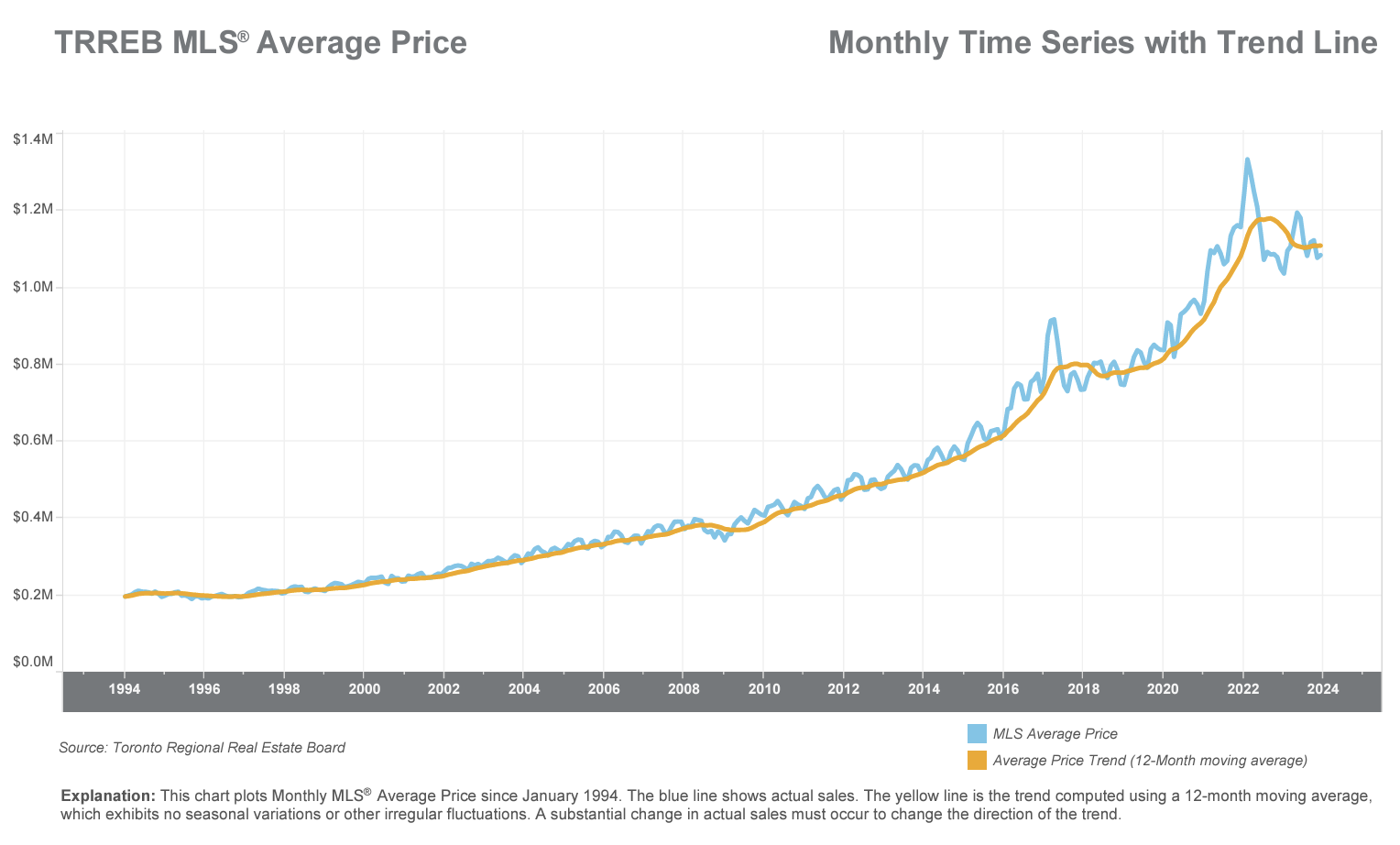
After the aggressive run up in 2021 and early 2022, the Toronto housing market has largely corrected back to late 2020 and early 2021 pricing levels.

This is not speculation. This is visible directly in the median sale price data across all property types.

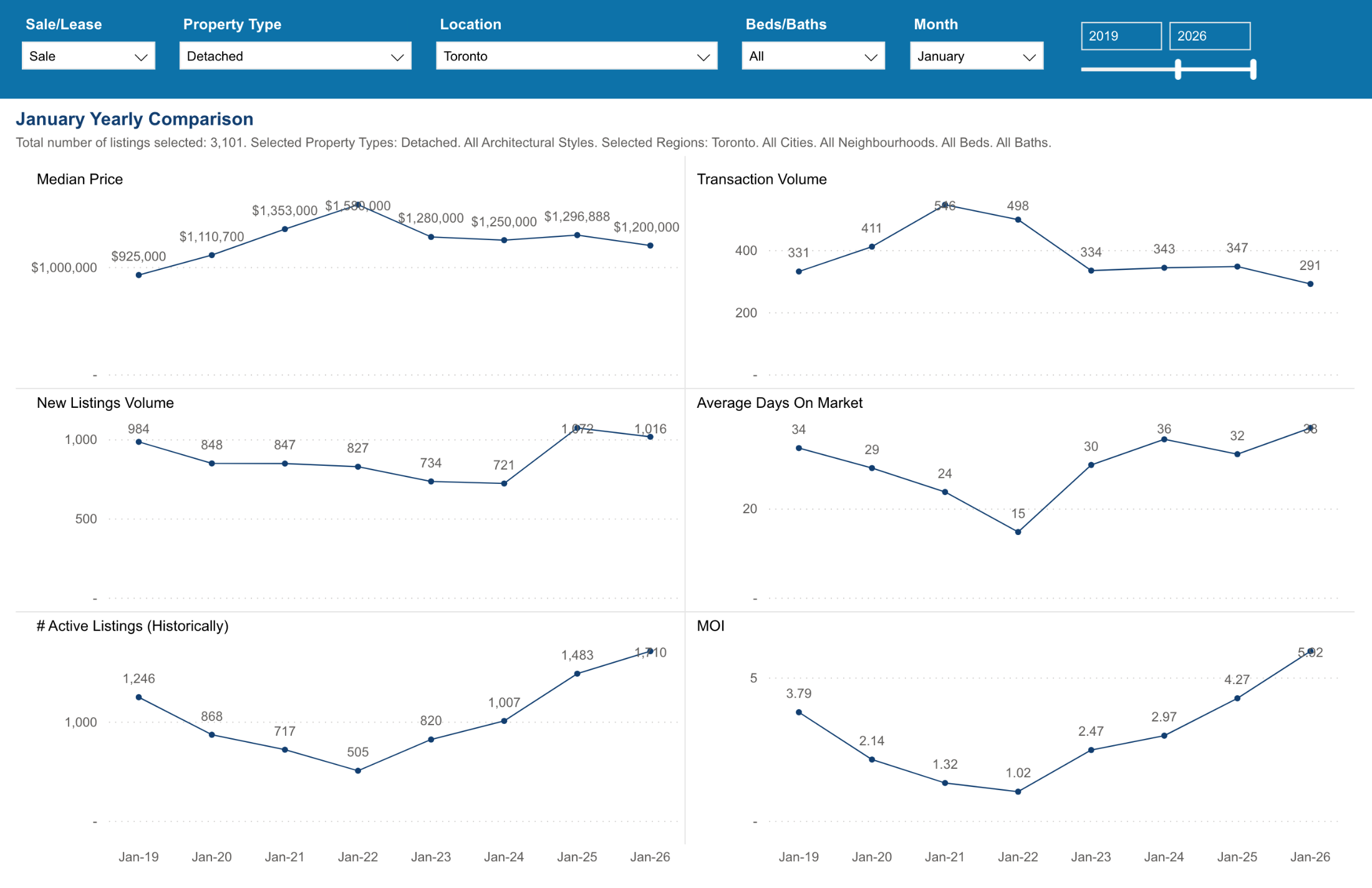
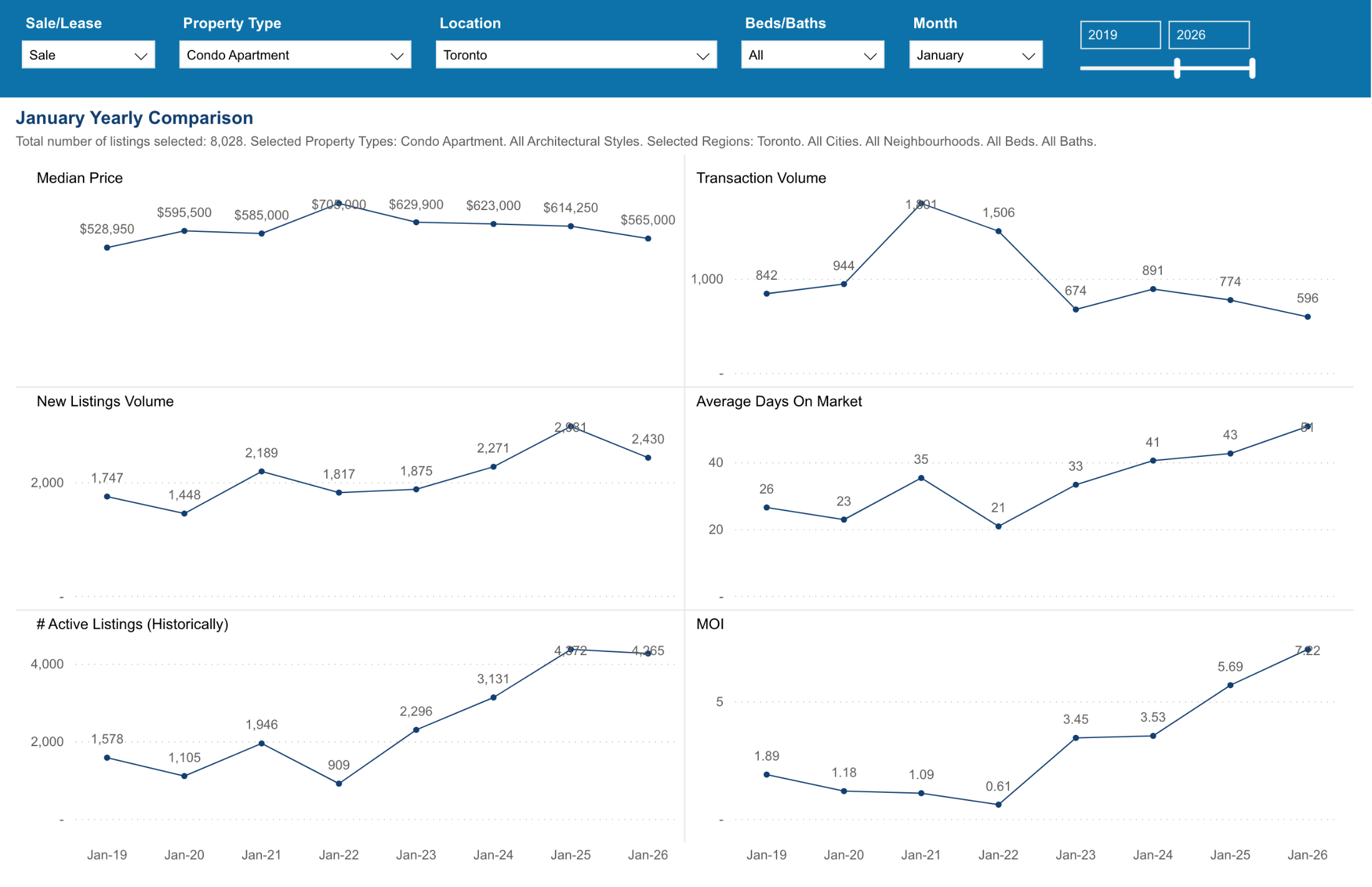
As of January 2026, median home prices in Toronto are:

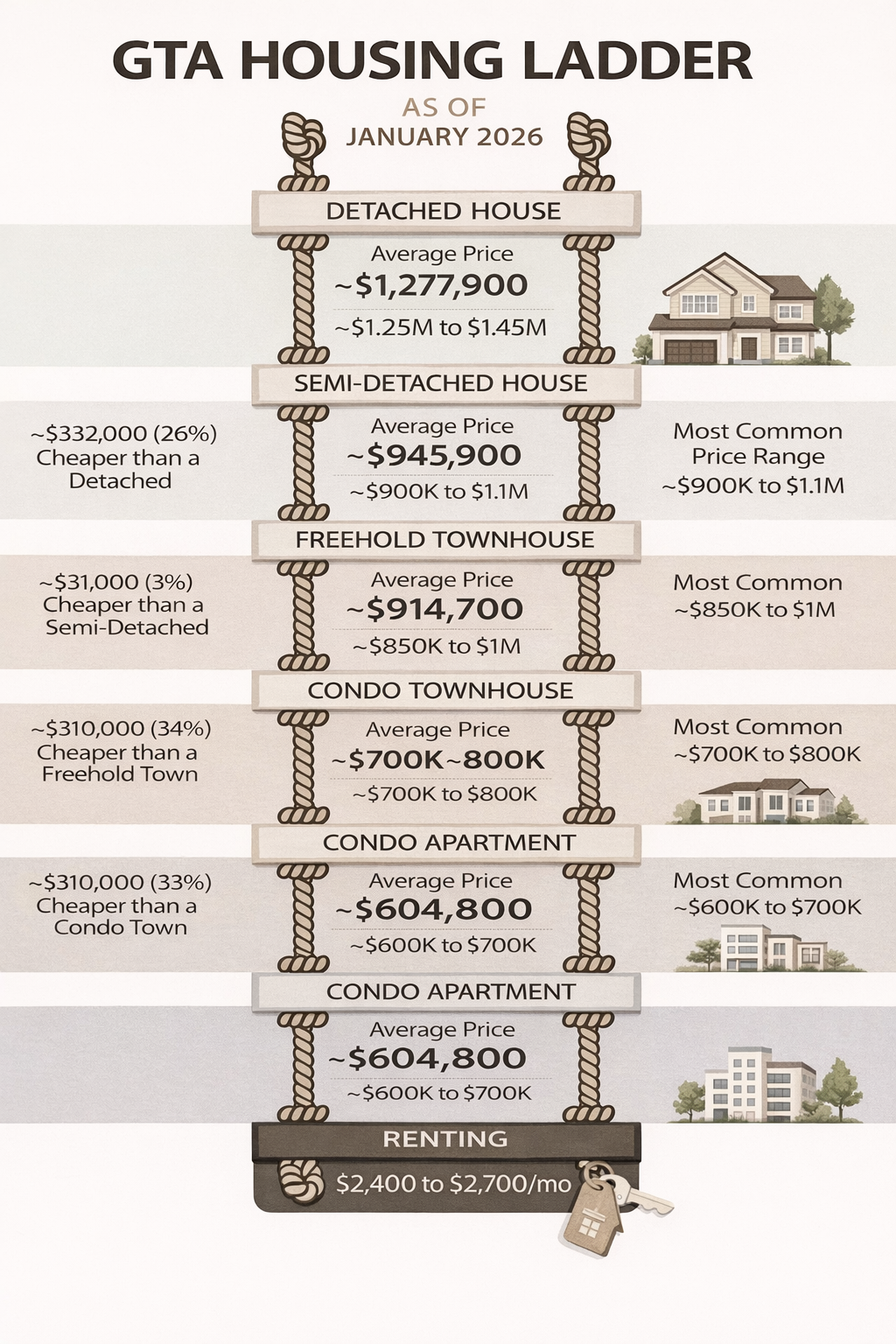
• Detached: $1,200,000
• Semi Detached: $994,000
• Condo Townhouse: $692,500
• Condo Apartment: $565,000

When you compare these numbers to historical pricing, something important stands out.

Condo vs Detached COnsultation

Toronto Real Estate Prices Have Reset to 2020 Levels

Looking at monthly median sale prices from January 2020 through January 2026:

Condo apartment prices around $565,000 were last seen in mid 2020.

Condo townhouses near $690,000 were typical in late 2020.

Semi detached homes around $990,000 closely match late 2020 pricing.

Detached homes around $1.2M were common in late 2020 and early 2021, before the speculative surge.

In other words, the majority of the 2021 to early 2022 premium has been removed from the market.

Toronto detached home prices and Toronto condo prices have effectively repriced to what buyers could sustainably afford before ultra low interest rates distorted demand.

What Happened Between 2021 and 2022

From early 2021 to Q1 2022, Toronto real estate entered a speculative phase.

Detached homes surged above $1.6M.
Semi detached homes moved well beyond $1.3M.
Condo townhouses approached $900,000.
Condo apartments climbed into the high $600,000 range.

This was driven by:

• Ultra low mortgage rates
• Cheap variable financing
• Pandemic driven space demand
• Investor speculation
• Fear of missing out

Months of inventory collapsed. Days on market compressed. Buyers competed aggressively.

That was not normal market behavior. That was a liquidity driven expansion.

Then rates rose. Affordability tightened. The market corrected.

Toronto Condo Prices in 2026

Today, Toronto condo prices reflect normalization rather than collapse.

At $565,000 median for condo apartments, prices are back to 2020 affordability levels.

Inventory is higher. Investor activity has cooled. Buyers are more disciplined.

For end users, this creates a more stable entry point compared to the speculative peak.

Condo townhouses at $692,500 remain attractive for buyers seeking more space without entering detached price territory.

Toronto Detached Home Prices in 2026

Toronto detached home prices now sit at $1.2M median.

While this is lower than peak 2022 levels, it is still structurally supported by limited land supply in the city.

The key difference today is psychology.

Buyers are no longer assuming automatic appreciation.

They are stress testing financing.

They are negotiating.

They are making rational decisions.

Are We at the Bottom of the Toronto Housing Market?

No one can perfectly time the market.

However, real estate cycles are stretched out and slow moving.

Markets expand.
They peak.
They contract.
They stabilize.

The data strongly suggests that Toronto home prices in 2026 are moving through the trough phase of the cycle.

Prices have corrected.
Speculative premiums have been removed.
Affordability has recalibrated.

The excess has been washed out.

Why This Is a Strategic Moment for First Time Home Buyers in Toronto

If you are a first time home buyer in Toronto, today’s market conditions are fundamentally different from 2022.

You now have:

• Negotiation power
• More inventory options
• Less bidding competition
• Sellers with realistic expectations
• Pricing that resembles 2020 levels

Buying during euphoria is emotional.

Buying during normalization is strategic.

If you were priced out during the peak, the current Toronto housing market may represent the most rational entry point in years.

You Cannot Time the Market, But You Can Align Your Life

The best time to buy real estate in Toronto is not when headlines say the market is hot.

It is when:

• Your income is stable
• Your down payment is ready
• Your lifestyle needs have evolved
• You are planning for children
• You are upsizing or downsizing intentionally
• Your long term financial plan is aligned

Real estate should serve your life.

Not the other way around.

My Approach to Helping Buyers Navigate Toronto Home Prices

As a data driven Toronto realtor, my focus is not on hype.

It is on:

• Understanding real estate cycles
• Evaluating affordability realistically
• Running stress test scenarios
• Protecting buyers from speculative behavior
• Building long term equity intentionally

You can never perfectly time the Toronto housing market.

But you can enter it intelligently.

Ready to Buy in Toronto in 2026?

If you are researching Toronto condo prices or Toronto detached home prices and wondering whether now is the right time, let’s build a plan.

Whether you are a first time home buyer, upgrading from a condo, or downsizing strategically, the key is disciplined execution.

The cycle will turn again.

The question is whether you will be positioned correctly when it does.

If you want to explore your options, run affordability scenarios, or understand which property type fits your long term goals, reach out.

Let’s build your strategy based on data, not emotion.

Talk to Elie

More Trend Charts for Condos and Detached homes

Read

Why Mortgage Pre-Approval Is Step One for First-Time Buyers

If you are thinking about buying in Toronto in 2026, especially as a first-time home buyer, mortgage pre-approval should be your first move.

In today’s market, preparation and clarity matter more than ever.

Talk to Elie

What Is Pre-Approval

A mortgage pre-approval is when a lender reviews your income, debts, credit, and down payment to determine

  • How much you qualify for

  • Your estimated interest rate

  • Your maximum monthly payment

  • Whether you pass the stress test

It gives you a clear budget before you start viewing homes.

Why It Is Critical for First-Time Buyers

As a first-time buyer, you are navigating

  • Land transfer tax

  • Closing costs

  • Condo fees

  • Insurance requirements

  • Available government incentives

Pre-approval helps you understand your true affordability, not just the listing price.

It also strengthens your offer. Sellers take pre-approved buyers more seriously, especially in competitive situations.

How I Help

As your realtor, I facilitate introductions to trusted mortgage broker partners who

  • Compare multiple lenders, not just one bank

  • Structure your mortgage strategically

  • Help you optimize your down payment

  • Explain first-time buyer programs clearly

We align your financing with your long-term plan, not just this purchase.

Talk to Elie

The Bottom Line

The smartest buyers in 2026 start with structure.

If you are planning to buy your first home in Toronto, let’s build your strategy properly from pre-approval to closing day. Preparation is your advantage.

Read

2026 Will Be Another Difficult Year for Toronto Real Estate

Toronto’s housing market enters 2026 in a fragile position. The outlook looks very different depending on whether you’re watching the resale market or the pre-construction sector but in both cases, the coming year is more likely to bring continued stress than a sharp rebound.

Talk to Elie

Resale Market: Low Confidence Meets Rising Supply

Most housing analysts now agree that the resale market is likely to weaken further before it stabilizes. The reason is simple: demand remains suppressed while supply is quietly building.

Demand: Confidence, Not Just Rates

GTA home sales recently fell to their lowest levels in decades. While interest rates have played a role, the bigger force keeping buyers on the sidelines has been economic uncertainty and weak consumer confidence.

Global instability, volatile financial markets, and persistent inflation concerns have created an environment where households feel cautious. Even if mortgage rates drift slightly lower, uncertainty acts like a psychological rate hike.

When families are unsure about job security, business conditions, or broader economic stability, they delay major financial commitments especially purchasing real estate.

In this climate, buyers aren’t rushing. They are negotiating harder, taking longer to decide, and walking away more often.

Supply: Sellers Are Moving First

On the supply side, psychology has shifted.

In previous downturns, sellers would often wait for prices to recover. In 2026, many homeowners fear that waiting may mean accepting an even lower price later. That shift in mindset is bringing more listings to market.

At the same time, households that stretched financially during the ultra-low-rate era are still adjusting to today’s borrowing costs. Even modest financial strain can push owners to list sooner than planned.

When weak demand meets rising supply, prices typically face downward pressure particularly in the condo segment, where inventory is already elevated.

Pre-Construction Condos: A Market Reset

The pre-construction condo market didn’t just slow down it effectively stalled.

Sales dropped to historically low levels, reflecting a sharp reversal from the investor-driven boom of previous years. For much of the last decade, the pre-construction sector relied heavily on investors willing to purchase units based on projected appreciation and rental growth.

When expectations change, investor demand can disappear quickly.

Unlike resale sellers, builders cannot easily slash prices. Land acquisition costs, development charges, financing, and construction contracts are largely fixed. Cutting prices below a certain threshold would make many projects financially unviable.

As a result, developers delay launches, pause projects, or cancel them outright instead of selling at significant discounts.

This creates a paradox: weak sales today may mean reduced housing supply several years from now potentially planting the seeds for future volatility.

Talk to Elie

The Broader Structural Issue

Toronto housing in 2026 is being shaped less by interest rates alone and more by:

  • Household debt levels

  • Investor participation

  • Construction economics

  • Income-to-price affordability gaps

For years, prices outpaced local income growth. That imbalance now limits how quickly the market can recover. Sustainable recovery typically requires alignment between what homes cost and what households can realistically afford without excessive leverage.

What This Means for Buyers and Sellers

  • Buyers may continue to see more selection and stronger negotiating power, particularly in the condo segment.

  • Sellers need to price strategically and prepare for longer days on market.

  • Investors must evaluate deals based on cash flow and fundamentals rather than speculative appreciation.

  • End-users with stable income and long-term horizons may find 2026 presents selective opportunities but patience remains essential.

The Bottom Line

2026 is shaping up to be another challenging year for Toronto real estate.

The resale market remains under pressure as cautious buyers meet a growing pool of motivated sellers. The pre-construction market is still searching for equilibrium after a prolonged investor-driven expansion.

A meaningful recovery will likely depend less on short-term policy changes and more on restoring confidence and bringing prices back in line with local income fundamentals.

Real estate cycles are never permanent but they do require recalibration. 2026 appears to be part of that reset.

Talk to Elie

Read

Why Owning a Home in Canada Is More Than Stability. It’s a Tax-Advantaged Wealth Strategy

Owning a home in Canada has always been associated with stability, community, and creating a space aligned with your priorities at different life stages. Whether you're buying your first condo in Toronto, upgrading to a townhouse, or planning for a detached family home, real estate anchors your lifestyle.

But what many Canadians overlook is this:

Homeownership in Canada is also one of the most powerful tax-advantaged wealth-building strategies available.

And it’s not accidental.

Talk to Elie

Beyond Stability: Homeownership as Financial Architecture

Yes, owning a home gives you:

  • Stability in housing costs

  • A sense of community

  • Control over your environment

  • The ability to design a space aligned with your wellness and priorities

But the deeper advantage lies in how the Canadian tax system is designed.

Canada actively encourages homeownership, particularly for Canadians establishing long-term roots in cities like Toronto, because it strengthens the economy, promotes financial resilience, and builds intergenerational wealth. At the center of this design is one powerful concept:

The Principal Residence Exemption (PRE)

The Principal Residence Exemption (PRE) allows Canadians to sell their primary home without paying capital gains tax on the appreciation, provided it qualifies as their principal residence for the years owned.

This means:

If your home increases in value over 5, 10, or 20 years, you pay zero capital gains tax on that growth.

That is extraordinary.

Compare this with:

  • Stocks

  • Businesses

  • Investment properties

  • Cryptocurrency

All of these are subject to capital gains tax when sold.

Your primary residence is not.

Why the Government Designed It This Way

The Government of Canada supports homeownership because:

  • It drives economic activity (construction, services, lending, employment)

  • It builds household balance sheets

  • It strengthens communities

  • It creates long-term financial stability

When capital growth is an integral part of your life and your home sits at the center of it, you’re not just buying shelter.

You’re participating in a system intentionally built to reward you.

Wherever You Are on the Property Ladder

Whether you’re:

  • Buying your first condo

  • Moving into a townhouse

  • Upgrading to a detached home

  • Downsizing later in life

The tax structure remains the same.

Your principal residence is shielded from capital gains tax.

That protection compounds over time.

The Wealth Flywheel: PRE + RRSP Home Buyers’ Plan

Now here’s where it becomes powerful.

When you combine the Principal Residence Exemption with the Home Buyers’ Plan (HBP), you create a financial flywheel.

The Home Buyers’ Plan allows eligible buyers to withdraw up to $60,000 from their RRSP tax-free to purchase a home, provided it’s repaid over time.

This means:

You can use pre-tax savings to acquire an asset
That grows tax-free
And can later be sold tax-free

Side-by-Side Comparison

Adding the Home Buyers’ Plan (HBP)

Component Benefit
RRSP Contribution Tax deduction upfront
HBP Withdrawal Up to $60,000 tax-free for purchase

Example Scenario

Let’s say you purchase a condo in Toronto for $600,000.

Over 10 years, it appreciates to $900,000.

That’s $300,000 in capital growth.

If it’s your principal residence:

You pay $0 in capital gains tax.

If that were stocks:

You would owe tax on 50% of the gain.

That difference alone can be tens of thousands of dollars.

Why This Matters in Toronto

Toronto remains one of Canada’s strongest long-term real estate markets.

When you combine:

  • Urban growth

  • Infrastructure expansion (Ontario Line, transit, density)

  • Population inflow

  • Government-backed tax sheltering

You create a powerful foundation for wealth building.

Homeownership isn’t just about today’s mortgage. It’s about positioning yourself within a system designed to reward long-term participation.

Important Consideration: Tax Advantages Do Not Guarantee Appreciation

While the Principal Residence Exemption provides one of the most powerful tax shelters available to Canadians, it’s critical to understand the nuances.

  • Tax protection does not guarantee asset performance.

  • Not every residential property purchased as a primary residence will appreciate at the same rate and some may underperform relative to broader market averages.

  • Real estate is not homogeneous.

Long-term equity growth is influenced by measurable fundamentals, including:

  • Micro-location dynamics

  • Transit and infrastructure development

  • Supply pipelines and future inventory risk

  • Layout efficiency and functional design

  • Building quality and reserve fund health

  • Demographic migration patterns

  • Economic drivers in the surrounding area

Two properties in the same postal code can produce materially different long-term outcomes.

The Principal Residence Exemption shields capital gains from tax, but it does not create them.

Capital appreciation is driven by asset selection. This is where strategic guidance becomes essential.

A disciplined, data-informed acquisition process evaluates not just current market pricing, but long-term value drivers. Over the past decade, I have focused on helping a select group of clients make purchase decisions rooted in fundamentals, not momentum or emotion.

The objective is not simply to “own property.” It is to:

  • Acquire assets positioned for long-term equity growth

  • Protect downside risk

  • Align lifestyle needs with capital appreciation potential

When structured properly, your home serves both your personal priorities and your long-term financial architecture. This is where I come in to advise you on the ideal property fit.

Talk to Elie

Final Thoughts

Owning a home in Canada goes far beyond stability and lifestyle alignment.

It is:

  • A tax-efficient wealth strategy

  • A government-supported growth vehicle

  • A foundation for long-term financial resilience

When structured properly, your home becomes the center of both your life and your capital growth.

If you’d like to understand:

  • Where you sit on the property ladder

  • What type of property aligns with your life stage

  • How to structure your purchase strategically

  • Or how to combine PRE + RRSP Home Buyers’ Plan effectively

Talk to Elie

Let’s design a plan aligned with your goals, financially and personally.

Read

Toronto First-Time Home Buyers in 2026: What You Need to Know

If you're thinking about buying your first home in 2026, you're not alone. With prices stabilizing in parts of the GTA and inventory improving compared to peak pandemic years, first-time buyers are stepping back into the market, but with more strategy and more caution.

Here’s your complete 2026 guide to first-time home buying in Ontario, including government incentives, qualification rules, closing costs, and what actually happens on closing day.

Talk to Elie

1. Who Qualifies as a First-Time Home Buyer in Ontario?

For Land Transfer Tax (LTT) Rebate purposes, you must meet the following criteria:

  • Be at least 18 years old

  • Occupy the home as your principal residence within 9 months

  • Never have owned a home anywhere in the world

  • If you have a spouse, they must also not have owned a home while being your spouse

  • Be a Canadian Citizen or Permanent Resident

  • The LTT rebate does not reset (unlike the RRSP Home Buyers’ Plan)

These criteria are outlined clearly in the legal reference document provided First Time Homebuyer

2. Land Transfer Tax Rebates (2026)

When you purchase in Ontario, you pay provincial land transfer tax. If you buy in Toronto, you also pay municipal land transfer tax.

Maximum Rebates Available:

  • Ontario LTT Rebate: Up to $4,000

  • Toronto Municipal LTT Rebate: Up to $4,475

Good news:
The rebate is applied directly on closing, you don’t need to pay first and apply later First Time Homebuyer

If you're buying with a parent or co-owner and you only own 50%, you only receive 50% of the rebate.

In Ontario, provincial land transfer tax ranges from 0.5% to 2.5% of the purchase price (with 2.5% applied on amounts above $2 million), and if you purchase in Toronto, you must also pay a municipal land transfer tax at the same graduated rates (0.5% to 2.5%), effectively doubling the land transfer tax within the City of Toronto.

3. Estimated Closing Costs in 2026

Beyond your down payment, here’s what to budget:

Expense Estimated Cost
Legal Fees ~$1,399 + HST
Disbursements ~$600 + HST
Title Insurance ~0.1% of purchase price
Ontario Registration Fees $168.46
Toronto LTT Admin Fee $115
Property Tax Adjustments Varies
Condo Fee Adjustments (if applicable) Varies

These figures are consistent with the legal breakdown in the reference PDF First Time Homebuyer

Pro Tip: Plan for approximately 1.5%–4% of the purchase price in total closing costs (depending on rebates and price point).

4. Federal Incentives Available in 2026

 Home Buyers’ Plan (HBP)

  • Withdraw up to $60,000 from your RRSP tax-free

  • Must repay over 15 years

  • Resets after 4 years of not owning a home

First Home Savings Account (FHSA)

  • Contribute up to $8,000 per year

  • Lifetime maximum: $40,000

  • Contributions are tax-deductible

  • Withdrawals are tax-free when used for first home purchase

First-Time Home Buyers’ Tax Credit

  • Non-refundable tax credit

  • Provides up to $1,500 in tax savings

5. Mortgage Preparation: What Most Buyers Get Wrong

The #1 issue causing closing delays? Mortgage problems.

Lenders typically need 3 full weeks to properly underwrite and fund your mortgage First Time Homebuyer

You should:

  • Get pre-approved early

  • Provide all documents (CRA NOAs, employment letters, proof of savings, gift letters)

  • Sign your mortgage commitment at least 3 weeks before closing First Time Homebuyer

In 2026, lenders are stricter than they were in 2021. Debt ratios, credit scores, and employment stability matter more than ever.

6. Insurance Requirements Before Closing

You must arrange property insurance at least one week before closing and send confirmation to your lawyer First Time Homebuyer

No insurance = no mortgage funds = breach of contract.

Condo insurance is generally cheaper than house insurance.

7. Utilities, Rental Equipment & Condo Forms

Before closing, you must:

  • Set up hydro, gas, water accounts

  • Transfer rental agreements (hot water tank, HVAC, etc.)

  • Complete condominium owner forms if buying a condo First Time Homebuyer

8. Meeting With Your Lawyer

You’ll meet your lawyer about one week before closing to sign documents as a First Time Homebuyer.

It may be virtual (Zoom/Docusign), depending on your lender.

Don’t book international travel during this week.

9. Deposit Funds to Lawyer’s Trust Account

After signing:

  • Obtain a certified cheque or bank draft

  • Deposit funds at least one day before closing

  • Mortgage lender wires funds to lawyer First Time Homebuyer

10. What Happens on Closing Day?

  • Deals typically close between 4–5pm

  • Don’t book movers in the morning

  • Keys are released once funds are confirmed

  • Test appliances within 24–48 hours First Time Homebuyer

The 2026 Market Reality for First-Time Buyers

Here’s what I’m seeing in Toronto:

  • More inventory than 2021–2022

  • Buyers negotiating 2–5% below asking in many condo segments

  • Stricter financing conditions

  • Sellers who overpaid during peak years may struggle to close

This means:

✅ More negotiation power
✅ More due diligence required
✅ More importance on strong representation

Talk to Elie

Final Advice

Buying your first home in 2026 is absolutely achievable, but it requires preparation, strategy, and the right team.

You need:

  • A sharp real estate agent

  • A proactive mortgage broker

  • An experienced real estate lawyer

Have a question?

If you're planning to buy your first home in Toronto this year, let’s start the conversation early. I’ll introduce you to my trusted team. Highly experienced real estate lawyers and mortgage brokers, and together we’ll build a clear plan from pre-approval all the way to closing day.

Read

Housing Affordability Explained

Housing affordability is a hot topic in Canada, but what does it actually mean?

At its core, housing affordability measures how much of your income goes toward owning a home. A common benchmark is the percentage of income needed to cover mortgage payments, property taxes, and utilities.

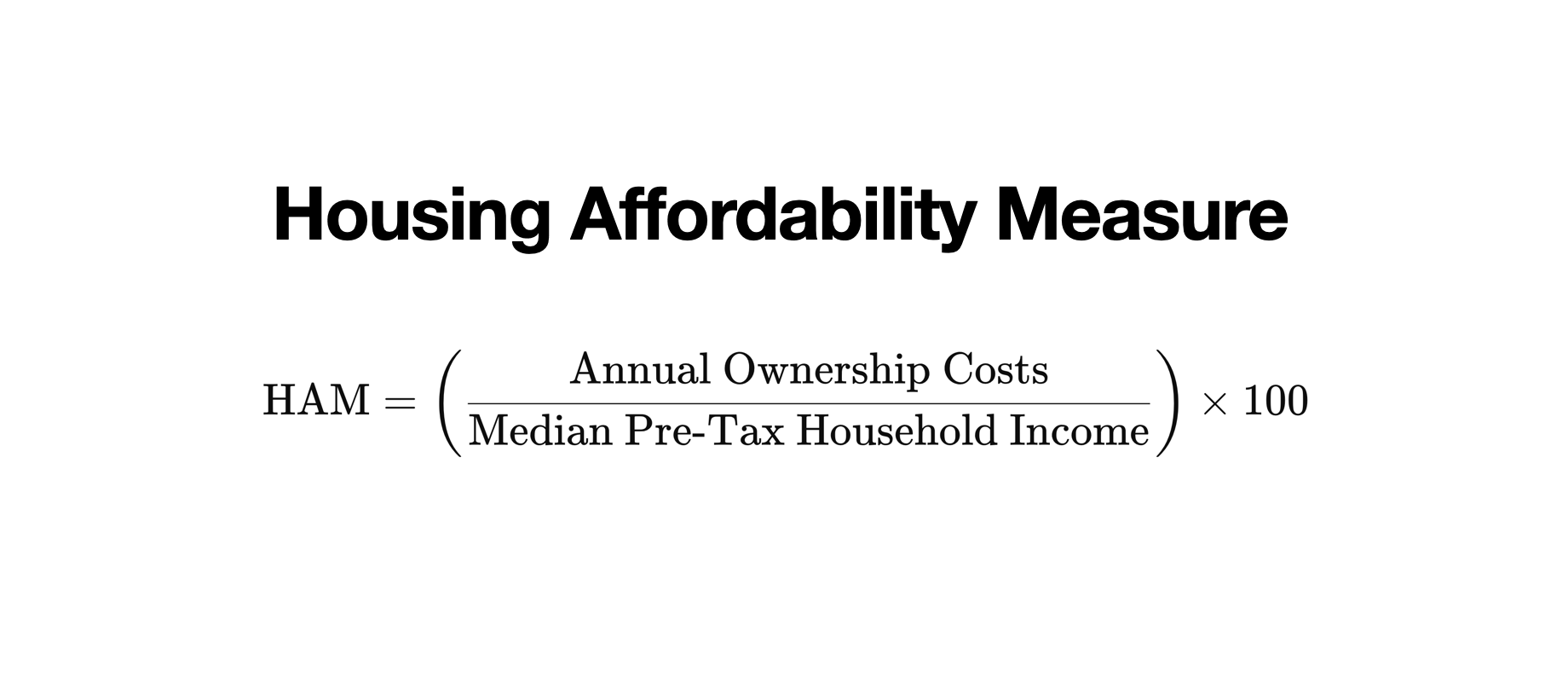
For example, RBC Economics tracks affordability by calculating how much of a median pre-tax household income is required to afford a typical home. In cities like Toronto and Vancouver, that number can be over 60%, making homeownership extremely challenging for many families.

Talk to Elie

To give you a clearer picture, here’s a snapshot of affordability in some Toronto neighbourhoods:

NeighbourhoodMedian IncomeHome PriceAffordability Ratio
Rosedale$120,000$3,000,00025x income
Forest Hill$126,300$2,500,00020x income
Leslieville$90,200$1,400,00015x income
Trinity Bellwoods$90,000$1,800,00020x income
Oakville (town-wide)$136,600$1,400,00010x income
  • High Affordability Ratios: Neighbourhoods like Rosedale and Forest Hill exhibit higher affordability ratios, indicating that a significant portion of household income would be required to purchase a median-priced home.

  • Mid-Range Ratios: Areas such as Trinity Bellwoods and Leslieville have moderate affordability ratios, suggesting a more balanced relationship between income and home prices.

  • Lower Ratios: Oakville shows lower affordability ratios, which may indicate that home prices are more accessible relative to household incomes in these areas.

Affordability ratio here is a simplified price-to-income ratio to illustrate the scale of costs relative to incomes.

Generally, a home is considered affordable if it costs less than 4 to 5 times your household income. As you can see, many Toronto neighbourhoods are far above that.

Why It Matters

When the affordability ratio gets too high, it means buyers may have to stretch their budgets, delay homeownership, or rely on financial help.

Understanding housing affordability can help you make informed decisions about where — and how — to buy. If you’re feeling stuck, you're not alone, and there are strategies to navigate this market wisely.

Want help breaking down what’s affordable for you?

Talk to Elie

Read

The Truth About Housing Affordability in Canada: Why the Headlines Aren’t Telling You Everything

Housing affordability is one of the biggest topics in Canada today — and for good reason. For many residents and newcomers, homeownership feels increasingly out of reach. Every day, we see headlines, reports, and politicians throwing around bold claims about the state of our housing market. But for how serious and important this conversation is, it deserves a lot more nuance than it currently gets.

It’s naive to think we can boil down the complexity of our economic and housing systems into a single, one-size-fits-all metric. And yet, that’s exactly what keeps happening.

So let’s unpack the core metric that everyone loves to quote: housing affordability.

Talk to Elie

The Metric Everyone Cites - But Few Understand

In Canada, housing affordability is most commonly measured using the Home Price-to-Income ratio, or more specifically, the ratio of average home prices to median disposable income.

But another widely referenced approach comes from RBC Economics, which calculates housing affordability by determining the proportion of median pre-tax household income needed to cover ownership costs — including mortgage payments, property taxes, and utilities. In this blog post we will stick to the RBC Housing Affordability Measure (HAM) when referring to housing affordability.

Right now, in major cities like Toronto and Vancouver, that number exceeds 60–80% of pre-tax income, levels RBC itself describes as “extremely high.”

Sounds simple, right? But simplicity here is deceiving. Because when you dig into how these metrics are calculated, you’ll see the cracks and they’re big enough to change the entire conversation.

Why CRA-Reported Income Is Not the Whole Story

Let’s take Toronto as an example. In some of the city's most affluent neighbourhoods — think Rosedale, Forest Hill, The Bridle Path — the average home sells for $4 to $6 million. But according to CRA and StatsCan data, the median household income in these areas is often reported around $120,000–$150,000. That doesn't add up. 

Estimated HAM by Neighbourhood in Toronto

NeighbourhoodMedian IncomeMedian Detached Home PriceEstimated Annual Ownership CostEstimated HAM (%)
Rosedale$120,000$3,000,000~$252,000~84%
Forest Hill$126,300$2,500,000~$210,000~83%
Bridle Path$229,400$5,000,000~$420,000~83–84%
High Park$105,600$1,800,000~$151,200~84%
The Beaches$102,000$1,500,000~$126,000~84%
Leslieville$90,200$1,400,000~$119,000~83%
Trinity Bellwoods$90,000$1,800,000~$151,200~84%
Lawrence Park$183,000$3,500,000~$294,000~84%
Oakville (town‑wide)$136,600$1,400,000~$114,000~83–84%

To learn more about the housing affordability metric, check out this blog post Housing Affordability Explained

2 key reasons why CRA income data gives a distorted view of reality:

1. Entrepreneurs Often Report Lower Incomes on Purpose

Many business owners, consultants, and independent professionals structure their finances in tax-efficient ways. This often means reporting lower personal income while reinvesting in their business or drawing from corporate accounts in non-taxable ways.

These individuals still live in high-end homes, vacation internationally, and pay for private school — yet none of that lifestyle is reflected in their CRA income.

2. Debt Is a Key Financial Tool for Wealthier Households

In today’s financial system, debt is not a sign of distress — it's a tool for leverage. Whether through Home Equity Lines of Credit (HELOCs), refinancing, or interest-only mortgages, affluent homeowners are able to tap into the equity in their homes to finance their lifestyles.

And none of this “liquidity” appears as income on their tax returns.

So if you're comparing average home prices to reported income, you're comparing real-time market prices to a filtered version of financial reality.

Debt Per Capita in Canada Is Soaring

To add even more weight to this argument, consider this: Canada now has one of the highest household debt-to-income ratios in the world.

According to the Bank of Canada, Canadian household debt now exceeds 180% of disposable income. That means for every $1 of after-tax income, Canadians owe $1.80.

This rise in debt is especially prominent in cities like Toronto and Vancouver, where home prices have outpaced income growth for decades.

So while affordability ratios may suggest housing is completely unaffordable — many Canadians are still buying homes. How? Through debt.

Example 1: The Incorporated Consultant (Using Dividends + Retained Earnings)

Profile: A self-employed consultant runs their business through a corporation and reports $100K in personal income through dividends.
Reality:

  • The corporation earns $400K annually but retains most of the profits within the company.

  • The consultant draws out just enough to maintain a modest personal income (lowering personal taxes).

  • Meanwhile, the corporation pays for a car, business travel, even part of the home office expenses.

  • The consultant secures a mortgage using stated income or net-worth lending, and buys a $2.5M home with a large down payment.

  • Living expenses are supplemented using a HELOC secured against the home or funds drawn from the corporation.

Result: Modest CRA income, low personal taxes, high actual cash flow.

The Multigenerational Household

Profile: A family reports $100K combined income across two adults.
Reality:

  • They purchased their home with the help of extended family (e.g., parents helping with down payment).

  • Parents co-sign on the mortgage or lend money interest-free.

  • The household’s living expenses are shared, lowering the per-person burden.

  • Home equity is tapped through a HELOC to renovate, invest, or fund a business.

Result: Ownership in a high-priced neighbourhood, low reported income, but solid family-backed financing.

What Does This Mean for You?

If you're a first-time buyer, immigrant, or simply trying to make sense of the market — don’t let national affordability ratios define your sense of possibility.

They’re based on averages, aggregates, and incomplete income data. They don’t reflect your unique financial situation, your potential for growth, or your long-term goals.

More importantly, they don’t account for the real drivers of purchasing power today: financial structuring, equity, and access to credit.

The Bottom Line

Housing affordability is complex, and that’s exactly why we need to stop oversimplifying it.

Yes, prices are high. Yes, income growth hasn’t kept pace. But the numbers we rely on to measure the gap? They’re based on flawed assumptions.

So before you let the headlines scare you, ask better questions. Look beyond the ratios. And if you need clarity tailored to your situation, connect with someone who understands how this system really works.

I'm here to help you do exactly that. Let’s connect and start the conversation early.

Talk to Elie

Read

How Come Housing Affordability Is Less of an Issue for Canadian Immigrants?

Housing affordability dominates the headlines in Canada, and for good reason. The numbers look discouraging, the outlook feels bleak, and the conversation is often framed in absolutes: “Homeownership is out of reach,” “The dream is dead,” or “We’ve hit a crisis point.”

But ask many immigrants across Canada, and you’ll hear a different story. Not because they have it easier, quite the opposite, but because their journey is built on sacrifice, strategy, and long-term vision.

Talk to Elie

The Immigrant Mindset: A Quiet Force Behind the Numbers

When newcomers arrive in Canada, they’re not just looking for a job or a house. They’re chasing a dream:
To build a better life.
To belong.
To contribute.
To thrive.

The path is rarely smooth. Many start from scratch, juggling student loans, entry-level jobs, unfamiliar norms, language barriers, and long-distance family obligations. And yet, through it all, there’s a remarkable consistency in how many immigrants approach their future: with humility, determination, and patience.

By the time they enter the workforce, many newcomers have been saving every month, often since the day they landed. They’ve internalized a mindset where every dollar counts. Nothing is too small to set aside.

Ask any immigrant around you:

What sacrifices did you make before buying your first home in Canada?

They’ll tell you stories, of skipping dinners out, declining vacations, delaying car purchases, limiting shopping, and sticking to strict budgets. They didn’t just save; they structured their lives around the belief that one day they could and would own a home.

They didn’t see affordability through the lens of statistics or headlines. They saw it as a strategic goal.

Perseverance Over Headlines

The media loves to deliver sensational messages:
“Millennials may never own homes.”
“Toronto is unaffordable for anyone under 40.”
“Buying property is a losing game.”

But for many immigrants, those narratives hold little weight. Not because they’re disconnected from reality, but because they’ve learned to play the long game.

To an immigrant who’s moved continents, learned a new language, built a network from scratch, and established a professional foothold in a foreign system, housing isn’t just a market transaction. It’s a symbol of stability. It’s the reward for years of effort. It's the foundation for the life they came here to build.

And when you’re driven by that kind of purpose, no headline or affordability ratio can convince you to give up.

So, Is Housing Truly Affordable?

That depends on how you define affordability, and more importantly, how you define success.

If we only look at housing through the lens of price-to-income ratios, yes, it looks discouraging. But if we dig deeper, we realize those numbers often fail to capture the sacrifices, resilience, and multi-year strategies that many immigrants employ to achieve their homeownership goals.

These families aren’t working miracles. They’re simply committed. They’re choosing discipline over instant gratification. They’re rejecting short-term pessimism in favour of long-term planning. And most importantly, they’re doing it with deep respect and gratitude for the country that gave them the opportunity to dream again.

A Call to Broaden the Narrative

Canada’s housing conversation needs more nuance. We need to move beyond the averages and aggregates and start listening to real stories, stories of people who worked tirelessly, saved diligently, and refused to give up.

Because when you zoom in, housing affordability isn’t just an economic issue. It’s a story of values, sacrifice, belief, and belonging. And no spreadsheet can capture that.

Let’s start the conversation early, I’d love to help you on this journey.

Talk to Elie

Read

The Shift Is Here: Why Purpose-Built Rentals Are Dominating Toronto Real Estate in 2025

Real estate, like everything else, is cyclical. It pulls in the unprepared, rewards the strategic, and resets itself over time. Toronto’s market is no exception. After a decade dominated by condo launches and investor-driven flipping, the rhythm is shifting and those paying attention are already adapting.

Talk to Elie

Condo Slowdown, Rental Surge

Roughly 18 months ago, Ontario’s new condo construction slowed to a crawl. High interest rates, elevated construction costs, and investor fatigue forced many developers to hit pause.

But that didn’t stop residential development. It just changed shape.

Enter Purpose-Built Rentals (PBRs) large-scale rental communities backed by institutional capital, often offering better layouts, family-friendly amenities, and long-term stability.

Condo Inventory Hits a Wall

According to Urbanation, in Q2-2025:

24,045 pre-construction units in Toronto remain unsold, that’s equivalent to 60 months of supply, and 55% of new condo units launched in Q1-2025 went unsold, just shy of a 30-year record.

“Project cancellations are mounting, construction starts are collapsing, jobs are being lost, buyers are losing a lot of money…” Shaun Hildebrand, President, Urbanation. Since 2024, 28 pre-sale projects (5,700+ units) have been paused, cancelled, or converted to rentals.

PBRs: The New Face of Urban Housing

This shift is reinforced by massive government investment: In 2025, the federal government pledged $15 billion to support 30,000+ new rental units across Canada. Over the next five years, up to $40 billion will be invested in rental supply via programs like the Apartment Construction Loan Program and Housing Accelerator Fund. Toronto alone expects 8,872 new purpose-built rental units to be delivered in 2025, the most in decades.

Meanwhile, Urbanation and FRPO (The Federation of Rental-Housing Providers of Ontario) estimate 55% of existing rental sites in the GTHA can support infill development, representing potential for over 182,000 new units.

What It Means for Renters

At first glance, Purpose-Built Rentals (PBRs) might seem like a win for tenants. Many advertise generous move-in incentives, 1 to 3 months of free rent, gift cards, or free parking, but the real cost kicks in later.

Here’s the catch: PBRs are run by institutions, pension funds, REITs, and private equity firms, who are in the business of maximizing shareholder returns, not offering long-term affordability. Because these buildings are newer than November 2018, they’re exempt from Ontario’s rent control guidelines. That means landlords can increase rents by any amount once your lease is up, provided 90 days' notice is given.

📍 Real examples from tenants across Toronto:

  • In buildings like The Selby (Sherbourne & Bloor) or The Livmore (Bay & Gerrard), renters have reported rent hikes of 10%–15% in year two, well beyond the Ontario guideline of 2.5%.

  • At eCentral at Yonge & Eglinton, tenants moving in with 2-month incentives found themselves paying up to $300 more/month when renewing.

  • Similar stories are being shared from Forma at Yonge & College, The Parker at Yonge & Eglinton, and even new buildings along Front Street in downtown's East Bayfront.

In addition, monthly costs are higher in many PBRs:

  • Utilities (water, hydro, and even heating/cooling) are often extra and based on usage, not bundled like older buildings.

  • Service fees like locker maintenance, pet cleaning stations, digital concierge, or package room access may not be disclosed upfront.

Bottom line: Ask current tenants what their rent is now, not just what it started at. Incentives might mask the real affordability challenges after year one.

What It Means for Buyers on the Sidelines

If you're currently renting or waiting for the “right time to buy,” this shift toward institutional rentals might impact your timeline more than you think.

As more units shift from ownership (condos) to long-term rentals (PBRs), we may see less inventory available to purchase in the coming years. Developers are choosing the steady returns of institutional leasing over pre-construction volatility. That means fewer units for sale, and the ones that remain may come with premium pricing due to scarcity and larger floor plans aimed at end-users.

So, while it might feel safer to “wait and see,” many buyers may find themselves competing for a shrinking pool of ownership opportunities, especially in core areas with good transit, schools, or future growth.

For renters who plan to stay in Toronto long-term, owning could offer more control and cost certainty than jumping from lease to lease under fluctuating rents.

Talk to Elie

Here’s My Role

Whether you're a first-time buyer, growing family ready to upsize, planning for retirement I’m here to guide you every step of the way. I’ve helped hundreds of buyers and sellers make informed, confident real estate decisions in Toronto.

Toronto real estate is transforming, but those who understand the rhythm of the cycle, not just the noise, will be the ones who thrive.

📩 Reach out if you want to chat strategy, timing, or what this shift means for your next move. Let’s make the market work for you.

Talk to Elie

Read
This website may only be used by consumers that have a bona fide interest in the purchase, sale, or lease of real estate of the type being offered via the website. The data relating to real estate on this website comes in part from the MLS® Reciprocity program of the PropTx MLS®. The data is deemed reliable but is not guaranteed to be accurate.