RSS

Toronto Home Prices 2026: Condo vs Detached Prices Reset to 2020 Levels

Toronto home prices in 2026 have corrected back to late 2020 levels. See updated condo, townhouse, semi-detached and detached prices and what it means for first time buyers.

If you are researching Toronto home prices in 2026, the data tells a very clear story.

After the aggressive run up in 2021 and early 2022, the Toronto housing market has largely corrected back to late 2020 and early 2021 pricing levels.

This is not speculation. This is visible directly in the median sale price data across all property types.

As of January 2026, median home prices in Toronto are:

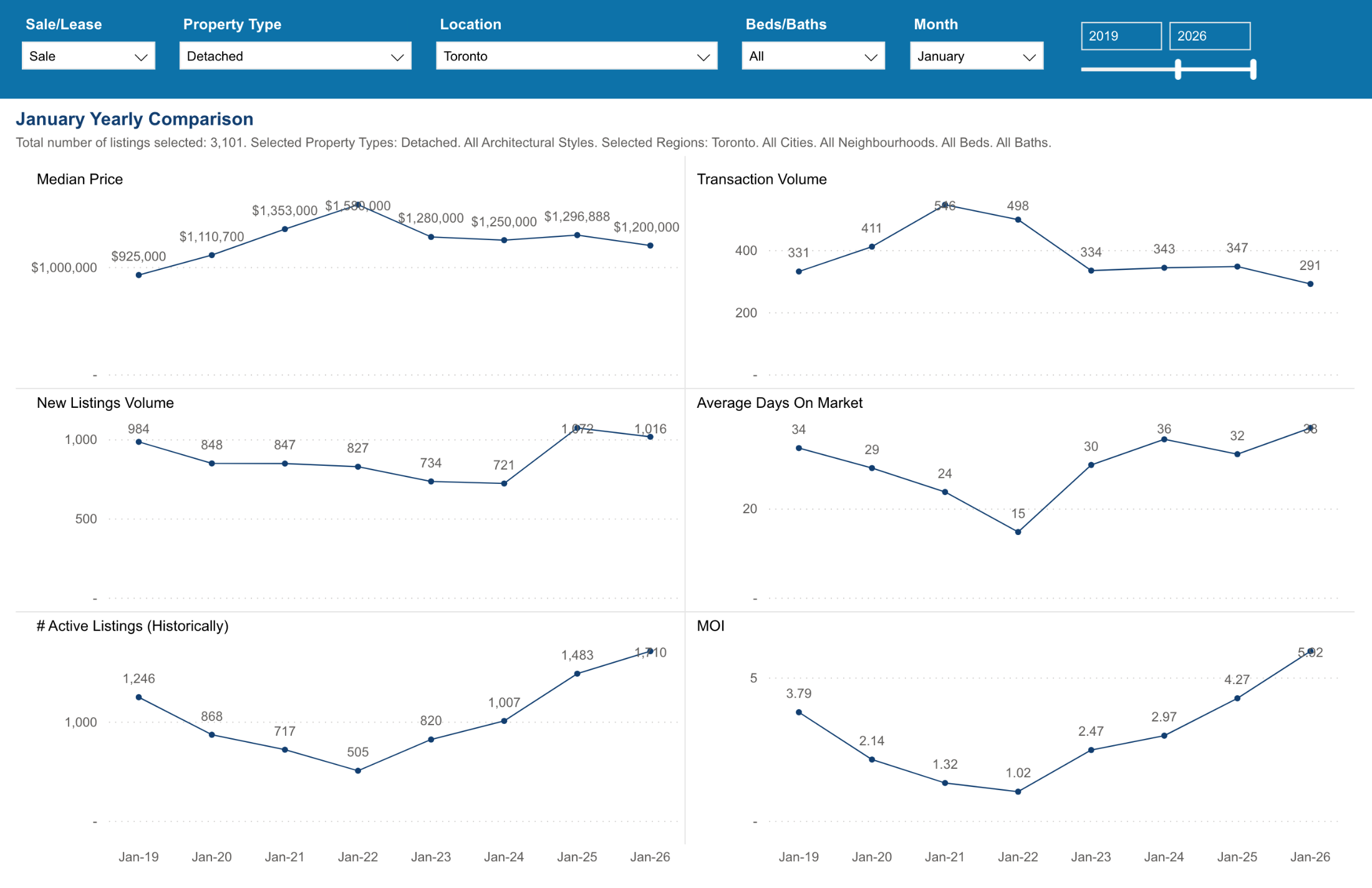
• Detached: $1,200,000
• Semi Detached: $994,000
• Condo Townhouse: $692,500
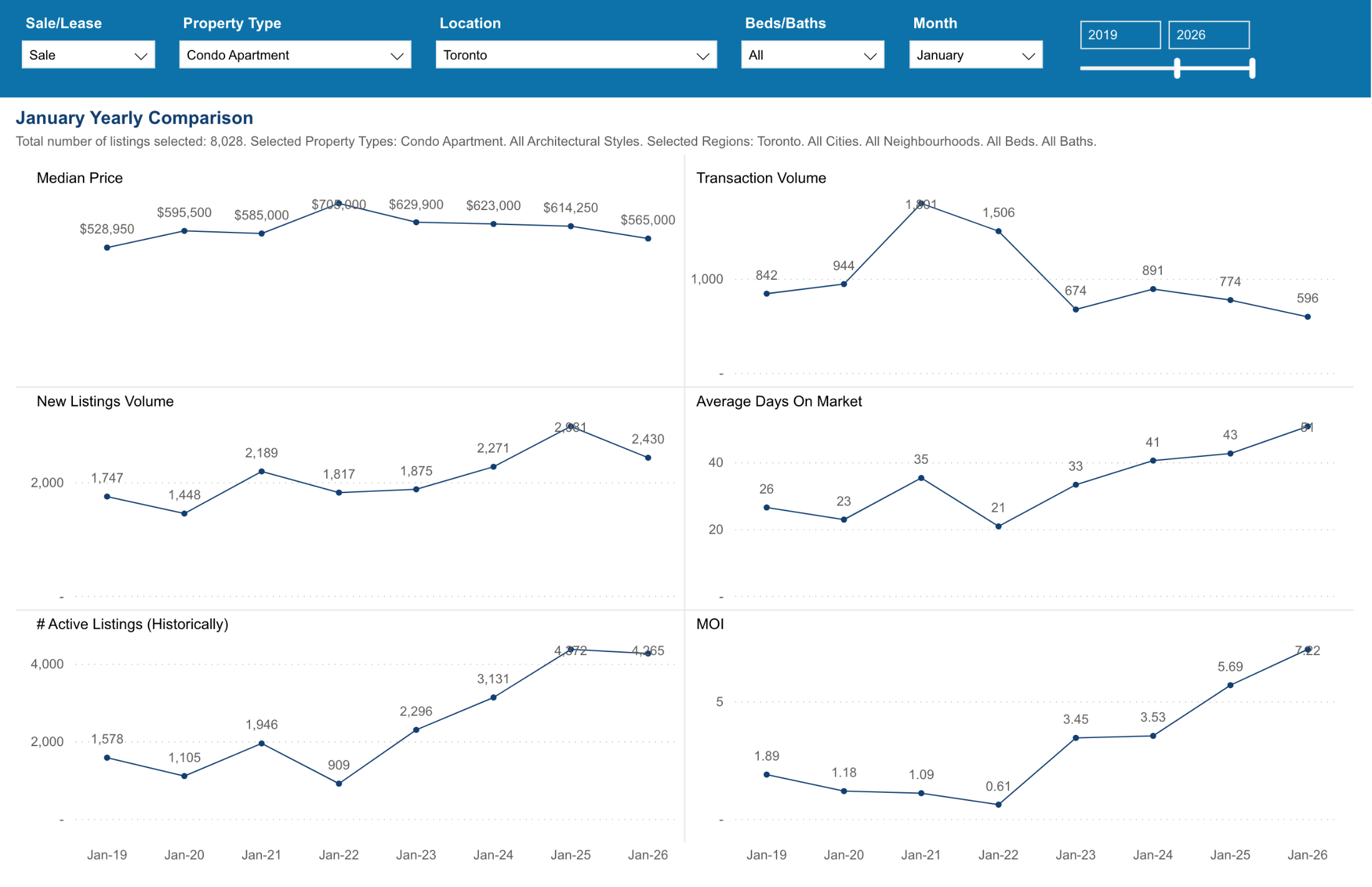
• Condo Apartment: $565,000

When you compare these numbers to historical pricing, something important stands out.

Talk to Elie

Toronto Real Estate Prices Have Reset to 2020 Levels

Looking at monthly median sale prices from January 2020 through January 2026:

Condo apartment prices around $565,000 were last seen in mid 2020.

Condo townhouses near $690,000 were typical in late 2020.

Semi detached homes around $990,000 closely match late 2020 pricing.

Detached homes around $1.2M were common in late 2020 and early 2021, before the speculative surge.

In other words, the majority of the 2021 to early 2022 premium has been removed from the market.

Toronto detached home prices and Toronto condo prices have effectively repriced to what buyers could sustainably afford before ultra low interest rates distorted demand.

What Happened Between 2021 and 2022

From early 2021 to Q1 2022, Toronto real estate entered a speculative phase.

Detached homes surged above $1.6M.
Semi detached homes moved well beyond $1.3M.
Condo townhouses approached $900,000.
Condo apartments climbed into the high $600,000 range.

This was driven by:

• Ultra low mortgage rates
• Cheap variable financing
• Pandemic driven space demand
• Investor speculation
• Fear of missing out

Months of inventory collapsed. Days on market compressed. Buyers competed aggressively.

That was not normal market behavior. That was a liquidity driven expansion.

Then rates rose. Affordability tightened. The market corrected.

Toronto Condo Prices in 2026

Today, Toronto condo prices reflect normalization rather than collapse.

At $565,000 median for condo apartments, prices are back to 2020 affordability levels.

Inventory is higher. Investor activity has cooled. Buyers are more disciplined.

For end users, this creates a more stable entry point compared to the speculative peak.

Condo townhouses at $692,500 remain attractive for buyers seeking more space without entering detached price territory.

Toronto Detached Home Prices in 2026

Toronto detached home prices now sit at $1.2M median.

While this is lower than peak 2022 levels, it is still structurally supported by limited land supply in the city.

The key difference today is psychology.

Buyers are no longer assuming automatic appreciation.

They are stress testing financing.

They are negotiating.

They are making rational decisions.

Are We at the Bottom of the Toronto Housing Market?

No one can perfectly time the market.

However, real estate cycles are stretched out and slow moving.

Markets expand.
They peak.
They contract.
They stabilize.

The data strongly suggests that Toronto home prices in 2026 are moving through the trough phase of the cycle.

Prices have corrected.
Speculative premiums have been removed.
Affordability has recalibrated.

The excess has been washed out.

Why This Is a Strategic Moment for First Time Home Buyers in Toronto

If you are a first time home buyer in Toronto, today’s market conditions are fundamentally different from 2022.

You now have:

• Negotiation power
• More inventory options
• Less bidding competition
• Sellers with realistic expectations
• Pricing that resembles 2020 levels

Buying during euphoria is emotional.

Buying during normalization is strategic.

If you were priced out during the peak, the current Toronto housing market may represent the most rational entry point in years.

You Cannot Time the Market, But You Can Align Your Life

The best time to buy real estate in Toronto is not when headlines say the market is hot.

It is when:

• Your income is stable
• Your down payment is ready
• Your lifestyle needs have evolved
• You are planning for children
• You are upsizing or downsizing intentionally
• Your long term financial plan is aligned

Real estate should serve your life.

Not the other way around.

My Approach to Helping Buyers Navigate Toronto Home Prices

As a data driven Toronto realtor, my focus is not on hype.

It is on:

• Understanding real estate cycles
• Evaluating affordability realistically
• Running stress test scenarios
• Protecting buyers from speculative behavior
• Building long term equity intentionally

You can never perfectly time the Toronto housing market.

But you can enter it intelligently.

Ready to Buy in Toronto in 2026?

If you are researching Toronto condo prices or Toronto detached home prices and wondering whether now is the right time, let’s build a plan.

Whether you are a first time home buyer, upgrading from a condo, or downsizing strategically, the key is disciplined execution.

The cycle will turn again.

The question is whether you will be positioned correctly when it does.

If you want to explore your options, run affordability scenarios, or understand which property type fits your long term goals, reach out.

Let’s build your strategy based on data, not emotion.

Talk to Elie

More Trend Charts for Condos and Detached homes
Read

New property listed in Toronto C01

I have listed a new property at 650 King Street W in Toronto. See details here

Experience boutique modern urban living in this stunning 1,086 sq ft 2 bedroom - 2 bathroomgenerous 95 sq ft balcony. Designed with 9-ft exposed concrete ceilings and floor-to-ceilingsuite in the heart of King West. 991 sq ft of meticulously designed interior space and awindows, this home blends modern style with functional comfort. The open-concept kitchenincludes an extra-wide marble-topped island, stainless steel appliances, and ample storageideal for everyday cooking and effortless entertaining. The open-concept living and diningarea extends seamlessly to a bright balcony, perfect for outdoor dining or unwinding with acloset and a sleek glass-enclosed en-suite shower. The second bedroom provides flexibility forview over the courtyard. The king-sized primary suite offers a peaceful retreat with a walk-inguests, a home office, or creative space, and is complemented by a full second bathroom.Additional highlights include in-suite laundry and generous storage throughout. This pet-friendly building offers premium amenities including a 24-hour concierge, a fully equippedgym, and an inner courtyard green space. 1 priority parking spot is included. Located stepsfrom the King Streetcar, the upcoming Ontario Line, parks, restaurants, cafes, galleries, andneighbourhoods.shops, this is a rare opportunity to own a split layout condo in one of Toronto's most vibrant

Read

Why Mortgage Pre-Approval Is Step One for First-Time Buyers

If you are thinking about buying in Toronto in 2026, especially as a first-time home buyer, mortgage pre-approval should be your first move.

In today’s market, preparation and clarity matter more than ever.

Talk to Elie

What Is Pre-Approval

A mortgage pre-approval is when a lender reviews your income, debts, credit, and down payment to determine

  • How much you qualify for

  • Your estimated interest rate

  • Your maximum monthly payment

  • Whether you pass the stress test

It gives you a clear budget before you start viewing homes.

Why It Is Critical for First-Time Buyers

As a first-time buyer, you are navigating

  • Land transfer tax

  • Closing costs

  • Condo fees

  • Insurance requirements

  • Available government incentives

Pre-approval helps you understand your true affordability, not just the listing price.

It also strengthens your offer. Sellers take pre-approved buyers more seriously, especially in competitive situations.

How I Help

As your realtor, I facilitate introductions to trusted mortgage broker partners who

  • Compare multiple lenders, not just one bank

  • Structure your mortgage strategically

  • Help you optimize your down payment

  • Explain first-time buyer programs clearly

We align your financing with your long-term plan, not just this purchase.

Talk to Elie

The Bottom Line

The smartest buyers in 2026 start with structure.

If you are planning to buy your first home in Toronto, let’s build your strategy properly from pre-approval to closing day. Preparation is your advantage.

Read

2026 Will Be Another Difficult Year for Toronto Real Estate

Toronto’s housing market enters 2026 in a fragile position. The outlook looks very different depending on whether you’re watching the resale market or the pre-construction sector but in both cases, the coming year is more likely to bring continued stress than a sharp rebound.

Talk to Elie

Resale Market: Low Confidence Meets Rising Supply

Most housing analysts now agree that the resale market is likely to weaken further before it stabilizes. The reason is simple: demand remains suppressed while supply is quietly building.

Demand: Confidence, Not Just Rates

GTA home sales recently fell to their lowest levels in decades. While interest rates have played a role, the bigger force keeping buyers on the sidelines has been economic uncertainty and weak consumer confidence.

Global instability, volatile financial markets, and persistent inflation concerns have created an environment where households feel cautious. Even if mortgage rates drift slightly lower, uncertainty acts like a psychological rate hike.

When families are unsure about job security, business conditions, or broader economic stability, they delay major financial commitments especially purchasing real estate.

In this climate, buyers aren’t rushing. They are negotiating harder, taking longer to decide, and walking away more often.

Supply: Sellers Are Moving First

On the supply side, psychology has shifted.

In previous downturns, sellers would often wait for prices to recover. In 2026, many homeowners fear that waiting may mean accepting an even lower price later. That shift in mindset is bringing more listings to market.

At the same time, households that stretched financially during the ultra-low-rate era are still adjusting to today’s borrowing costs. Even modest financial strain can push owners to list sooner than planned.

When weak demand meets rising supply, prices typically face downward pressure particularly in the condo segment, where inventory is already elevated.

Pre-Construction Condos: A Market Reset

The pre-construction condo market didn’t just slow down it effectively stalled.

Sales dropped to historically low levels, reflecting a sharp reversal from the investor-driven boom of previous years. For much of the last decade, the pre-construction sector relied heavily on investors willing to purchase units based on projected appreciation and rental growth.

When expectations change, investor demand can disappear quickly.

Unlike resale sellers, builders cannot easily slash prices. Land acquisition costs, development charges, financing, and construction contracts are largely fixed. Cutting prices below a certain threshold would make many projects financially unviable.

As a result, developers delay launches, pause projects, or cancel them outright instead of selling at significant discounts.

This creates a paradox: weak sales today may mean reduced housing supply several years from now potentially planting the seeds for future volatility.

Talk to Elie

The Broader Structural Issue

Toronto housing in 2026 is being shaped less by interest rates alone and more by:

  • Household debt levels

  • Investor participation

  • Construction economics

  • Income-to-price affordability gaps

For years, prices outpaced local income growth. That imbalance now limits how quickly the market can recover. Sustainable recovery typically requires alignment between what homes cost and what households can realistically afford without excessive leverage.

What This Means for Buyers and Sellers

  • Buyers may continue to see more selection and stronger negotiating power, particularly in the condo segment.

  • Sellers need to price strategically and prepare for longer days on market.

  • Investors must evaluate deals based on cash flow and fundamentals rather than speculative appreciation.

  • End-users with stable income and long-term horizons may find 2026 presents selective opportunities but patience remains essential.

The Bottom Line

2026 is shaping up to be another challenging year for Toronto real estate.

The resale market remains under pressure as cautious buyers meet a growing pool of motivated sellers. The pre-construction market is still searching for equilibrium after a prolonged investor-driven expansion.

A meaningful recovery will likely depend less on short-term policy changes and more on restoring confidence and bringing prices back in line with local income fundamentals.

Real estate cycles are never permanent but they do require recalibration. 2026 appears to be part of that reset.

Talk to Elie

Read

Why Owning a Home in Canada Is More Than Stability. It’s a Tax-Advantaged Wealth Strategy

Owning a home in Canada has always been associated with stability, community, and creating a space aligned with your priorities at different life stages. Whether you're buying your first condo in Toronto, upgrading to a townhouse, or planning for a detached family home, real estate anchors your lifestyle.

But what many Canadians overlook is this:

Homeownership in Canada is also one of the most powerful tax-advantaged wealth-building strategies available.

And it’s not accidental.

Talk to Elie

Beyond Stability: Homeownership as Financial Architecture

Yes, owning a home gives you:

  • Stability in housing costs

  • A sense of community

  • Control over your environment

  • The ability to design a space aligned with your wellness and priorities

But the deeper advantage lies in how the Canadian tax system is designed.

Canada actively encourages homeownership, particularly for Canadians establishing long-term roots in cities like Toronto, because it strengthens the economy, promotes financial resilience, and builds intergenerational wealth. At the center of this design is one powerful concept:

The Principal Residence Exemption (PRE)

The Principal Residence Exemption (PRE) allows Canadians to sell their primary home without paying capital gains tax on the appreciation, provided it qualifies as their principal residence for the years owned.

This means:

If your home increases in value over 5, 10, or 20 years, you pay zero capital gains tax on that growth.

That is extraordinary.

Compare this with:

  • Stocks

  • Businesses

  • Investment properties

  • Cryptocurrency

All of these are subject to capital gains tax when sold.

Your primary residence is not.

Why the Government Designed It This Way

The Government of Canada supports homeownership because:

  • It drives economic activity (construction, services, lending, employment)

  • It builds household balance sheets

  • It strengthens communities

  • It creates long-term financial stability

When capital growth is an integral part of your life and your home sits at the center of it, you’re not just buying shelter.

You’re participating in a system intentionally built to reward you.

Wherever You Are on the Property Ladder

Whether you’re:

  • Buying your first condo

  • Moving into a townhouse

  • Upgrading to a detached home

  • Downsizing later in life

The tax structure remains the same.

Your principal residence is shielded from capital gains tax.

That protection compounds over time.

The Wealth Flywheel: PRE + RRSP Home Buyers’ Plan

Now here’s where it becomes powerful.

When you combine the Principal Residence Exemption with the Home Buyers’ Plan (HBP), you create a financial flywheel.

The Home Buyers’ Plan allows eligible buyers to withdraw up to $60,000 from their RRSP tax-free to purchase a home, provided it’s repaid over time.

This means:

You can use pre-tax savings to acquire an asset
That grows tax-free
And can later be sold tax-free

Side-by-Side Comparison

Adding the Home Buyers’ Plan (HBP)

Component Benefit
RRSP Contribution Tax deduction upfront
HBP Withdrawal Up to $60,000 tax-free for purchase

Example Scenario

Let’s say you purchase a condo in Toronto for $600,000.

Over 10 years, it appreciates to $900,000.

That’s $300,000 in capital growth.

If it’s your principal residence:

You pay $0 in capital gains tax.

If that were stocks:

You would owe tax on 50% of the gain.

That difference alone can be tens of thousands of dollars.

Why This Matters in Toronto

Toronto remains one of Canada’s strongest long-term real estate markets.

When you combine:

  • Urban growth

  • Infrastructure expansion (Ontario Line, transit, density)

  • Population inflow

  • Government-backed tax sheltering

You create a powerful foundation for wealth building.

Homeownership isn’t just about today’s mortgage. It’s about positioning yourself within a system designed to reward long-term participation.

Important Consideration: Tax Advantages Do Not Guarantee Appreciation

While the Principal Residence Exemption provides one of the most powerful tax shelters available to Canadians, it’s critical to understand the nuances.

  • Tax protection does not guarantee asset performance.

  • Not every residential property purchased as a primary residence will appreciate at the same rate and some may underperform relative to broader market averages.

  • Real estate is not homogeneous.

Long-term equity growth is influenced by measurable fundamentals, including:

  • Micro-location dynamics

  • Transit and infrastructure development

  • Supply pipelines and future inventory risk

  • Layout efficiency and functional design

  • Building quality and reserve fund health

  • Demographic migration patterns

  • Economic drivers in the surrounding area

Two properties in the same postal code can produce materially different long-term outcomes.

The Principal Residence Exemption shields capital gains from tax, but it does not create them.

Capital appreciation is driven by asset selection. This is where strategic guidance becomes essential.

A disciplined, data-informed acquisition process evaluates not just current market pricing, but long-term value drivers. Over the past decade, I have focused on helping a select group of clients make purchase decisions rooted in fundamentals, not momentum or emotion.

The objective is not simply to “own property.” It is to:

  • Acquire assets positioned for long-term equity growth

  • Protect downside risk

  • Align lifestyle needs with capital appreciation potential

When structured properly, your home serves both your personal priorities and your long-term financial architecture. This is where I come in to advise you on the ideal property fit.

Talk to Elie

Final Thoughts

Owning a home in Canada goes far beyond stability and lifestyle alignment.

It is:

  • A tax-efficient wealth strategy

  • A government-supported growth vehicle

  • A foundation for long-term financial resilience

When structured properly, your home becomes the center of both your life and your capital growth.

If you’d like to understand:

  • Where you sit on the property ladder

  • What type of property aligns with your life stage

  • How to structure your purchase strategically

  • Or how to combine PRE + RRSP Home Buyers’ Plan effectively

Talk to Elie

Let’s design a plan aligned with your goals, financially and personally.

Read

Toronto First-Time Home Buyers in 2026: What You Need to Know

If you're thinking about buying your first home in 2026, you're not alone. With prices stabilizing in parts of the GTA and inventory improving compared to peak pandemic years, first-time buyers are stepping back into the market, but with more strategy and more caution.

Here’s your complete 2026 guide to first-time home buying in Ontario, including government incentives, qualification rules, closing costs, and what actually happens on closing day.

Talk to Elie

1. Who Qualifies as a First-Time Home Buyer in Ontario?

For Land Transfer Tax (LTT) Rebate purposes, you must meet the following criteria:

  • Be at least 18 years old

  • Occupy the home as your principal residence within 9 months

  • Never have owned a home anywhere in the world

  • If you have a spouse, they must also not have owned a home while being your spouse

  • Be a Canadian Citizen or Permanent Resident

  • The LTT rebate does not reset (unlike the RRSP Home Buyers’ Plan)

These criteria are outlined clearly in the legal reference document provided First Time Homebuyer

2. Land Transfer Tax Rebates (2026)

When you purchase in Ontario, you pay provincial land transfer tax. If you buy in Toronto, you also pay municipal land transfer tax.

Maximum Rebates Available:

  • Ontario LTT Rebate: Up to $4,000

  • Toronto Municipal LTT Rebate: Up to $4,475

Good news:
The rebate is applied directly on closing, you don’t need to pay first and apply later First Time Homebuyer

If you're buying with a parent or co-owner and you only own 50%, you only receive 50% of the rebate.

In Ontario, provincial land transfer tax ranges from 0.5% to 2.5% of the purchase price (with 2.5% applied on amounts above $2 million), and if you purchase in Toronto, you must also pay a municipal land transfer tax at the same graduated rates (0.5% to 2.5%), effectively doubling the land transfer tax within the City of Toronto.

3. Estimated Closing Costs in 2026

Beyond your down payment, here’s what to budget:

Expense Estimated Cost
Legal Fees ~$1,399 + HST
Disbursements ~$600 + HST
Title Insurance ~0.1% of purchase price
Ontario Registration Fees $168.46
Toronto LTT Admin Fee $115
Property Tax Adjustments Varies
Condo Fee Adjustments (if applicable) Varies

These figures are consistent with the legal breakdown in the reference PDF First Time Homebuyer

Pro Tip: Plan for approximately 1.5%–4% of the purchase price in total closing costs (depending on rebates and price point).

4. Federal Incentives Available in 2026

 Home Buyers’ Plan (HBP)

  • Withdraw up to $60,000 from your RRSP tax-free

  • Must repay over 15 years

  • Resets after 4 years of not owning a home

First Home Savings Account (FHSA)

  • Contribute up to $8,000 per year

  • Lifetime maximum: $40,000

  • Contributions are tax-deductible

  • Withdrawals are tax-free when used for first home purchase

First-Time Home Buyers’ Tax Credit

  • Non-refundable tax credit

  • Provides up to $1,500 in tax savings

5. Mortgage Preparation: What Most Buyers Get Wrong

The #1 issue causing closing delays? Mortgage problems.

Lenders typically need 3 full weeks to properly underwrite and fund your mortgage First Time Homebuyer

You should:

  • Get pre-approved early

  • Provide all documents (CRA NOAs, employment letters, proof of savings, gift letters)

  • Sign your mortgage commitment at least 3 weeks before closing First Time Homebuyer

In 2026, lenders are stricter than they were in 2021. Debt ratios, credit scores, and employment stability matter more than ever.

6. Insurance Requirements Before Closing

You must arrange property insurance at least one week before closing and send confirmation to your lawyer First Time Homebuyer

No insurance = no mortgage funds = breach of contract.

Condo insurance is generally cheaper than house insurance.

7. Utilities, Rental Equipment & Condo Forms

Before closing, you must:

  • Set up hydro, gas, water accounts

  • Transfer rental agreements (hot water tank, HVAC, etc.)

  • Complete condominium owner forms if buying a condo First Time Homebuyer

8. Meeting With Your Lawyer

You’ll meet your lawyer about one week before closing to sign documents as a First Time Homebuyer.

It may be virtual (Zoom/Docusign), depending on your lender.

Don’t book international travel during this week.

9. Deposit Funds to Lawyer’s Trust Account

After signing:

  • Obtain a certified cheque or bank draft

  • Deposit funds at least one day before closing

  • Mortgage lender wires funds to lawyer First Time Homebuyer

10. What Happens on Closing Day?

  • Deals typically close between 4–5pm

  • Don’t book movers in the morning

  • Keys are released once funds are confirmed

  • Test appliances within 24–48 hours First Time Homebuyer

The 2026 Market Reality for First-Time Buyers

Here’s what I’m seeing in Toronto:

  • More inventory than 2021–2022

  • Buyers negotiating 2–5% below asking in many condo segments

  • Stricter financing conditions

  • Sellers who overpaid during peak years may struggle to close

This means:

✅ More negotiation power
✅ More due diligence required
✅ More importance on strong representation

Talk to Elie

Final Advice

Buying your first home in 2026 is absolutely achievable, but it requires preparation, strategy, and the right team.

You need:

  • A sharp real estate agent

  • A proactive mortgage broker

  • An experienced real estate lawyer

Have a question?

If you're planning to buy your first home in Toronto this year, let’s start the conversation early. I’ll introduce you to my trusted team. Highly experienced real estate lawyers and mortgage brokers, and together we’ll build a clear plan from pre-approval all the way to closing day.

Read
This website may only be used by consumers that have a bona fide interest in the purchase, sale, or lease of real estate of the type being offered via the website. The data relating to real estate on this website comes in part from the MLS® Reciprocity program of the PropTx MLS®. The data is deemed reliable but is not guaranteed to be accurate.