RSS

Housing Affordability Explained

Housing affordability is a hot topic in Canada — but what does it actually mean?

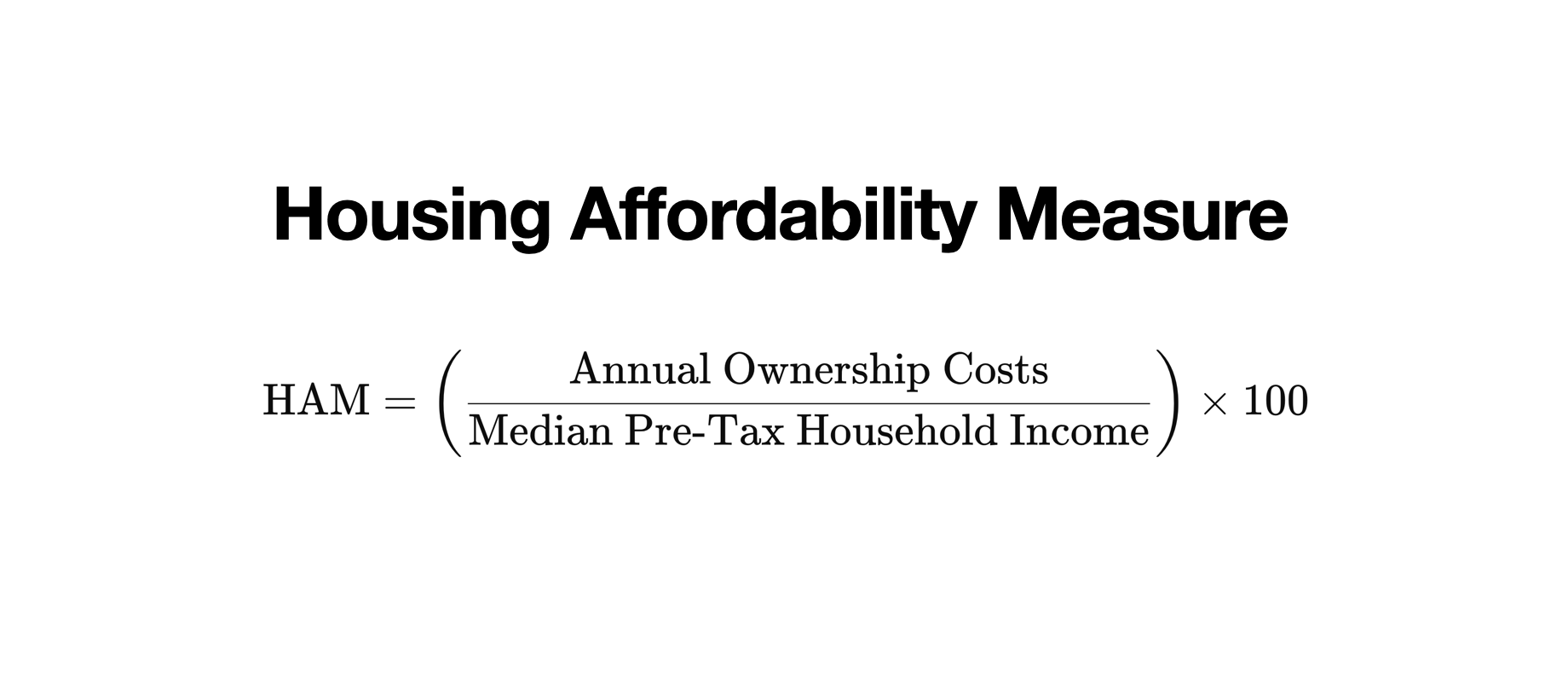
At its core, housing affordability measures how much of your income goes toward owning a home. A common benchmark is the percentage of income needed to cover mortgage payments, property taxes, and utilities.

For example, RBC Economics tracks affordability by calculating how much of a median pre-tax household income is required to afford a typical home. In cities like Toronto and Vancouver, that number can be over 60%, making homeownership extremely challenging for many families.

To give you a clearer picture, here’s a snapshot of affordability in some Toronto neighbourhoods:

NeighbourhoodMedian IncomeHome PriceAffordability Ratio
Rosedale$120,000$3,000,00025x income
Forest Hill$126,300$2,500,00020x income
Leslieville$90,200$1,400,00015x income
Trinity Bellwoods$90,000$1,800,00020x income
Oakville (town-wide)$136,600$1,400,00010x income
  • High Affordability Ratios: Neighbourhoods like Rosedale and Forest Hill exhibit higher affordability ratios, indicating that a significant portion of household income would be required to purchase a median-priced home.

  • Mid-Range Ratios: Areas such as Trinity Bellwoods and Leslieville have moderate affordability ratios, suggesting a more balanced relationship between income and home prices.

  • Lower Ratios: Oakville shows lower affordability ratios, which may indicate that home prices are more accessible relative to household incomes in these areas.

Affordability ratio here is a simplified price-to-income ratio to illustrate the scale of costs relative to incomes.

Generally, a home is considered affordable if it costs less than 4 to 5 times your household income. As you can see, many Toronto neighbourhoods are far above that.

Why It Matters

When the affordability ratio gets too high, it means buyers may have to stretch their budgets, delay homeownership, or rely on financial help.

Understanding housing affordability can help you make informed decisions about where — and how — to buy. If you’re feeling stuck, you're not alone, and there are strategies to navigate this market wisely.

Want help breaking down what’s affordable for you? Let’s talk.

Read

The Truth About Housing Affordability in Canada: Why the Headlines Aren’t Telling You Everything

Housing affordability is one of the biggest topics in Canada today — and for good reason. For many residents and newcomers, homeownership feels increasingly out of reach. Every day, we see headlines, reports, and politicians throwing around bold claims about the state of our housing market. But for how serious and important this conversation is, it deserves a lot more nuance than it currently gets.

It’s naive to think we can boil down the complexity of our economic and housing systems into a single, one-size-fits-all metric. And yet, that’s exactly what keeps happening.

So let’s unpack the core metric that everyone loves to quote: housing affordability.

The Metric Everyone Cites — But Few Understand

In Canada, housing affordability is most commonly measured using the Home Price-to-Income ratio, or more specifically, the ratio of average home prices to median disposable income.

But another widely referenced approach comes from RBC Economics, which calculates housing affordability by determining the proportion of median pre-tax household income needed to cover ownership costs — including mortgage payments, property taxes, and utilities. In this blog post we will stick to the RBC Housing Affordability Measure (HAM) when referring to housing affordability.

Right now, in major cities like Toronto and Vancouver, that number exceeds 60–80% of pre-tax income — levels RBC itself describes as “extremely high.”

Sounds simple, right? But simplicity here is deceiving. Because when you dig into how these metrics are calculated, you’ll see the cracks — and they’re big enough to change the entire conversation.

Why CRA-Reported Income Is Not the Whole Story

Let’s take Toronto as an example. In some of the city's most affluent neighbourhoods — think Rosedale, Forest Hill, The Bridle Path — the average home sells for $4 to $6 million. But according to CRA and StatsCan data, the median household income in these areas is often reported around $120,000–$150,000. That doesn't add up. 

Estimated HAM by Neighbourhood in Toronto

NeighbourhoodMedian IncomeMedian Detached Home PriceEstimated Annual Ownership CostEstimated HAM (%)
Rosedale$120,000$3,000,000~$252,000~84%
Forest Hill$126,300$2,500,000~$210,000~83%
Bridle Path$229,400$5,000,000~$420,000~83–84%
High Park$105,600$1,800,000~$151,200~84%
The Beaches$102,000$1,500,000~$126,000~84%
Leslieville$90,200$1,400,000~$119,000~83%
Trinity Bellwoods$90,000$1,800,000~$151,200~84%
Lawrence Park$183,000$3,500,000~$294,000~84%
Oakville (town‑wide)$136,600$1,400,000~$114,000~83–84%

To learn more about the housing affordability metric, check out this blog post Housing Affordability Explained

2 key reasons why CRA income data gives a distorted view of reality:

1. Entrepreneurs Often Report Lower Incomes on Purpose

Many business owners, consultants, and independent professionals structure their finances in tax-efficient ways. This often means reporting lower personal income while reinvesting in their business or drawing from corporate accounts in non-taxable ways.

These individuals still live in high-end homes, vacation internationally, and pay for private school — yet none of that lifestyle is reflected in their CRA income.

2. Debt Is a Key Financial Tool for Wealthier Households

In today’s financial system, debt is not a sign of distress — it's a tool for leverage. Whether through Home Equity Lines of Credit (HELOCs), refinancing, or interest-only mortgages, affluent homeowners are able to tap into the equity in their homes to finance their lifestyles.

And none of this “liquidity” appears as income on their tax returns.

So if you're comparing average home prices to reported income — you're comparing real-time market prices to a filtered version of financial reality.

Debt Per Capita in Canada Is Soaring

To add even more weight to this argument, consider this: Canada now has one of the highest household debt-to-income ratios in the world.

According to the Bank of Canada, Canadian household debt now exceeds 180% of disposable income. That means for every $1 of after-tax income, Canadians owe $1.80.

This rise in debt is especially prominent in cities like Toronto and Vancouver, where home prices have outpaced income growth for decades.

So while affordability ratios may suggest housing is completely unaffordable — many Canadians are still buying homes. How? Through debt.

Example 1: The Incorporated Consultant (Using Dividends + Retained Earnings)

Profile: A self-employed consultant runs their business through a corporation and reports $100K in personal income through dividends.
Reality:

  • The corporation earns $400K annually but retains most of the profits within the company.

  • The consultant draws out just enough to maintain a modest personal income (lowering personal taxes).

  • Meanwhile, the corporation pays for a car, business travel, even part of the home office expenses.

  • The consultant secures a mortgage using stated income or net-worth lending, and buys a $2.5M home with a large down payment.

  • Living expenses are supplemented using a HELOC secured against the home or funds drawn from the corporation.

Result: Modest CRA income, low personal taxes, high actual cash flow.

The Multigenerational Household

Profile: A family reports $100K combined income across two adults.
Reality:

  • They purchased their home with the help of extended family (e.g., parents helping with down payment).

  • Parents co-sign on the mortgage or lend money interest-free.

  • The household’s living expenses are shared, lowering the per-person burden.

  • Home equity is tapped through a HELOC to renovate, invest, or fund a business.

Result: Ownership in a high-priced neighbourhood, low reported income, but solid family-backed financing.

What Does This Mean for You?

If you're a first-time buyer, immigrant, or simply trying to make sense of the market — don’t let national affordability ratios define your sense of possibility.

They’re based on averages, aggregates, and incomplete income data. They don’t reflect your unique financial situation, your potential for growth, or your long-term goals.

More importantly, they don’t account for the real drivers of purchasing power today: financial structuring, equity, and access to credit.

The Bottom Line

Housing affordability is complex, and that’s exactly why we need to stop oversimplifying it.

Yes, prices are high. Yes, income growth hasn’t kept pace. But the numbers we rely on to measure the gap? They’re based on flawed assumptions.

So before you let the headlines scare you — ask better questions. Look beyond the ratios. And if you need clarity tailored to your situation, connect with someone who understands how this system really works.

I'm here to help you do exactly that. Let’s connect and start the conversation early.

Read

Housing affordability dominates the headlines in Canada — and for good reason. The numbers look discouraging, the outlook feels bleak, and the conversation is often framed in absolutes: “Homeownership is out of reach,” “The dream is dead,” or “We’ve hit a crisis point.”

But ask many immigrants across Canada, and you’ll hear a different story. Not because they have it easier — quite the opposite — but because their journey is built on sacrifice, strategy, and long-term vision.

The Immigrant Mindset: A Quiet Force Behind the Numbers

When newcomers arrive in Canada, they’re not just looking for a job or a house. They’re chasing a dream:
To build a better life.
To belong.
To contribute.
To thrive.

The path is rarely smooth. Many start from scratch — juggling student loans, entry-level jobs, unfamiliar norms, language barriers, and long-distance family obligations. And yet, through it all, there’s a remarkable consistency in how many immigrants approach their future: with humility, determination, and patience.

By the time they enter the workforce, many newcomers have been saving every month, often since the day they landed. They’ve internalized a mindset where every dollar counts. Nothing is too small to set aside.

Ask any immigrant around you:

What sacrifices did you make before buying your first home in Canada?

They’ll tell you stories — of skipping dinners out, declining vacations, delaying car purchases, limiting shopping, and sticking to strict budgets. They didn’t just save; they structured their lives around the belief that one day they could and would own a home.

They didn’t see affordability through the lens of statistics or headlines. They saw it as a strategic goal.

Perseverance Over Headlines

The media loves to deliver sensational messages:
“Millennials may never own homes.”
“Toronto is unaffordable for anyone under 40.”
“Buying property is a losing game.”

But for many immigrants, those narratives hold little weight. Not because they’re disconnected from reality — but because they’ve learned to play the long game.

To an immigrant who’s moved continents, learned a new language, built a network from scratch, and established a professional foothold in a foreign system, housing isn’t just a market transaction. It’s a symbol of stability. It’s the reward for years of effort. It's the foundation for the life they came here to build.

And when you’re driven by that kind of purpose, no headline or affordability ratio can convince you to give up.

So, Is Housing Truly Affordable?

That depends on how you define affordability — and more importantly, how you define success.

If we only look at housing through the lens of price-to-income ratios, yes, it looks discouraging. But if we dig deeper, we realize those numbers often fail to capture the sacrifices, resilience, and multi-year strategies that many immigrants employ to achieve their homeownership goals.

These families aren’t working miracles. They’re simply committed. They’re choosing discipline over instant gratification. They’re rejecting short-term pessimism in favour of long-term planning. And most importantly, they’re doing it with deep respect and gratitude for the country that gave them the opportunity to dream again.

A Call to Broaden the Narrative

Canada’s housing conversation needs more nuance. We need to move beyond the averages and aggregates and start listening to real stories — stories of people who worked tirelessly, saved diligently, and refused to give up.

Because when you zoom in, housing affordability isn’t just an economic issue. It’s a story of values, sacrifice, belief, and belonging. And no spreadsheet can capture that.

Let’s start the conversation early — I’d love to help you on this journey.

Read

The Shift Is Here: Why Purpose-Built Rentals Are Dominating Toronto Real Estate in 2025

Real estate, like everything else, is cyclical. It pulls in the unprepared, rewards the strategic, and resets itself over time. Toronto’s market is no exception. After a decade dominated by condo launches and investor-driven flipping, the rhythm is shifting and those paying attention are already adapting.

Condo Slowdown, Rental Surge

Roughly 18 months ago, Ontario’s new condo construction slowed to a crawl. High interest rates, elevated construction costs, and investor fatigue forced many developers to hit pause.

But that didn’t stop residential development. It just changed shape.

Enter Purpose-Built Rentals (PBRs) large-scale rental communities backed by institutional capital, often offering better layouts, family-friendly amenities, and long-term stability.

Condo Inventory Hits a Wall

According to Urbanation, in Q2-2025:

24,045 pre-construction units in Toronto remain unsold, that’s equivalent to 60 months of supply, and 55% of new condo units launched in Q1-2025 went unsold, just shy of a 30-year record.

“Project cancellations are mounting, construction starts are collapsing, jobs are being lost, buyers are losing a lot of money
” Shaun Hildebrand, President, Urbanation. Since 2024, 28 pre-sale projects (5,700+ units) have been paused, cancelled, or converted to rentals.

PBRs: The New Face of Urban Housing

This shift is reinforced by massive government investment: In 2025, the federal government pledged $15 billion to support 30,000+ new rental units across Canada. Over the next five years, up to $40 billion will be invested in rental supply via programs like the Apartment Construction Loan Program and Housing Accelerator Fund. Toronto alone expects 8,872 new purpose-built rental units to be delivered in 2025, the most in decades.

Meanwhile, Urbanation and FRPO (The Federation of Rental-Housing Providers of Ontario) estimate 55% of existing rental sites in the GTHA can support infill development, representing potential for over 182,000 new units.

What It Means for Renters

At first glance, Purpose-Built Rentals (PBRs) might seem like a win for tenants. Many advertise generous move-in incentives, 1 to 3 months of free rent, gift cards, or free parking, but the real cost kicks in later.

Here’s the catch: PBRs are run by institutions, pension funds, REITs, and private equity firms, who are in the business of maximizing shareholder returns, not offering long-term affordability. Because these buildings are newer than November 2018, they’re exempt from Ontario’s rent control guidelines. That means landlords can increase rents by any amount once your lease is up, provided 90 days' notice is given.

📍 Real examples from tenants across Toronto:

  • In buildings like The Selby (Sherbourne & Bloor) or The Livmore (Bay & Gerrard), renters have reported rent hikes of 10%–15% in year two, well beyond the Ontario guideline of 2.5%.

  • At eCentral at Yonge & Eglinton, tenants moving in with 2-month incentives found themselves paying up to $300 more/month when renewing.

  • Similar stories are being shared from Forma at Yonge & College, The Parker at Yonge & Eglinton, and even new buildings along Front Street in downtown's East Bayfront.

In addition, monthly costs are higher in many PBRs:

  • Utilities (water, hydro, and even heating/cooling) are often extra and based on usage, not bundled like older buildings.

  • Service fees like locker maintenance, pet cleaning stations, digital concierge, or package room access may not be disclosed upfront.

Bottom line: Ask current tenants what their rent is now, not just what it started at. Incentives might mask the real affordability challenges after year one.

What It Means for Buyers on the Sidelines

If you're currently renting or waiting for the “right time to buy,” this shift toward institutional rentals might impact your timeline more than you think.

As more units shift from ownership (condos) to long-term rentals (PBRs), we may see less inventory available to purchase in the coming years. Developers are choosing the steady returns of institutional leasing over pre-construction volatility. That means fewer units for sale, and the ones that remain may come with premium pricing due to scarcity and larger floor plans aimed at end-users.

So, while it might feel safer to “wait and see,” many buyers may find themselves competing for a shrinking pool of ownership opportunities, especially in core areas with good transit, schools, or future growth.

For renters who plan to stay in Toronto long-term, owning could offer more control and cost certainty than jumping from lease to lease under fluctuating rents.

Here’s My Role

Whether you're a first-time buyer, growing family ready to upsize, planning for retirement I’m here to guide you every step of the way. I’ve helped hundreds of buyers and sellers make informed, confident real estate decisions in Toronto.

Toronto real estate is transforming, but those who understand the rhythm of the cycle, not just the noise, will be the ones who thrive.

đŸ“© Reach out if you want to chat strategy, timing, or what this shift means for your next move. Let’s make the market work for you.

Read

You have time to be many different things

🐣From 50,000 Chickens to $1M deals: My Unexpected Path to Real Estate as an Immigrant to Canada 🇹🇩

In 2004, at just 14 years old, I started my first job helping my father run our family’s broiler poultry farm.

Every two months, we raised up to 50,000 chickens, feeding over 4,000 people a month in our community. It was high-stakes work. We had no systems, no software just instinct and hustle.

So I turned to Excel. Who knew this was going to be our 1st leap into digital transformation.

I started tracking everything manually:

  1. Livestock growth and health

  2. Humidity, temperature, water and diesel usage

  3. Feed consumption and conversion ratios

Then I built a tool to help us predict outcomes, minimize losses, and make better decisions. It worked to the point where we were in a position to utilize all the data insights to optimize operations, scale the business, and bring transparency to every process.

We scaled the farm. Modernized our systems. Increased shareholder returns. To the point where all investors managed to fund their children's university education abroad across the U.S., Canada, and the U.K.

Looking back, I didn’t know it then, but I was learning the fundamentals of data-driven problem-solving, risk management, and strategic thinking, skills I now use daily in real estate.

đŸŒ± Fast-forward 20 years


Today, I serve homebuyers, sellers, and investors across the Greater Toronto Area with that same mindset, grounded in curiosity, systems, and strategy.

My approach isn’t based on hype or guesswork. It’s based on what I call a Multifecta lens, a layered, research-based way of understanding what drives real estate value. It includes:

📊 Real estate market data: supply, demand, absorption rates, and price trends

đŸ—ïž Public infrastructure and investment: upcoming transit lines, zoning changes, and revitalization plans

🌆 Community development: school ratings, parks, retail anchors, and livability upgrades

🧠 Buyer and seller sentiment: what people are feeling, not just what they’re doing

🌐 Macroeconomic & political dynamics: fiscal & monetary government policies, immigration programs, and geopolitical events 

🔍 Why This Matters

Understanding sentiment, how buyers and sellers feel about the market, is often the missing piece. Emotions drive timing, pricing, and negotiation behaviour.

Through heavy research, economic insight, and ongoing conversations with other agents and clients, I help you tap into that layer.

As a buyer, this gives you an edge: you know when to act, when to wait, and how to craft offers that land.

As a seller, it helps us set realistic pricing, build trust with buyers, and maximize your net proceeds by anticipating what others will bring to the table.

💡 It’s Not About Guessing, it’s About Seeing the Whole Board

Real estate is emotional, but decisions don’t have to be impulsive.

Whether you’re buying your first home or selling your investment, I bring a research-backed, empathetic, and strategic approach to help you move with clarity and confidence.

✹ From chickens and spreadsheets to real estate and negotiations. Curiosity, partnerships, and making a positive impact in this universe still drive everything I do.

đŸ“© Curious about how this approach could support your real estate goals? Let’s connect.

Read

What It Means to List Your Property for Rent with Elie

Thank you for considering me to help rent out your property. I want to take a moment to explain what it means to list your property for rent when we work together, so you know exactly what to expect. 

Let’s break it down into 8 steps

1. Pricing Strategy & Market Analysis

Getting the price right is the first step to renting your property successfully. I start by conducting a detailed comparative market analysis (CMA) that looks at similar properties currently listed and recently leased in your building or neighborhood. I assess factors like square footage, layout, finishes, parking, and views to position your unit competitively.

Beyond the data, I also factor in seasonal demand trends, vacancy rates, and recent tenant behavior to determine what price point will attract strong interest without sitting on the market. The goal is to strike the perfect balance: maximizing your rental income while minimizing vacancy time and tenant turnover.

Once we lock in a price, I guide you on how to highlight your property’s strengths so it stands out against the competition—whether it’s natural light, storage, outdoor space, or proximity to transit.

2. Marketing Your Property

Once we sign a listing agreement, I’ll begin marketing your rental professionally. This includes:

  • High-quality photos (and video tours if needed)

  • A compelling, accurate property description

  • Posting on RE/MAX, MLS, and Realtor.ca

  • Promoting to my agent network and social media including Instagram, Facebook, TikTok, YouTube, and LinkedIn

3. Managing Showings

  • Scheduling & confirmation: I handle all appointment requests and use showing‑management software so you always know who’s coming and when.

  • Guided tours: I or a licensed REALTORÂź in Toronto attend every showing to spotlight key features and answer questions on the spot.

  • Security: Lights on/off, doors locked, and detailed sign‑in tracking for full accountability.

  • Feedback loop: Post‑showing summaries so you see how the market is responding in real time.

4. Tenant Screening

All prospective tenants will be carefully screened to ensure they meet your requirements. This includes:

  • Credit check via Equifax, TransUnion, or SingleKey

  • Employment and income verification, including:

    • Letter of employment

    • 1–2 months of recent pay stubs

  • References from previous landlords and their contact information

  • On a case-by-case basis, I may also request:

    • 3–6 months of recent bank statements (chequing/savings)

    • Official study permit

    • University or school registration confirmation

    • Proof of tuition payment

    • Valid work permit

    • Marriage certificate (to confirm shared responsibility of a dependent)

All documents are reviewed for authenticity and completeness before being presented to you.

5. Shortlisting Tenants for Your Review

I’ll only present you with qualified, pre-vetted candidates, so you save time and can feel confident in your decision. You’ll receive:

  • A summary of each candidate

  • All supporting documents in one place for easy comparison

  • My professional recommendation (but final decision is always yours)

6. Negotiating and Preparing Lease Documents

Once we identify an ideal tenant, I’ll take care of:

  • Negotiating lease price and terms to protect your interests

  • Drafting the Agreement to Lease (Form 400)

  • Ensuring deposits are submitted as a bank draft or certified cheque

  • Preparing the Ontario Standard Lease with supporting schedules

  • Collecting e-signatures from both parties

7. Move-In Coordination

After lease signing, I’ll guide the tenant through a smooth move-in process:

  • Utility transfer (hydro, gas, etc.)

  • Tenant’s property and liability insurance

  • Finalizing rent payment setup (e-transfer, cheques, or other)

  • Setting expectations for keys, access, and next steps

8. Key Handover

I’ll coordinate the key exchange either:

  • In person or

  • Via a lockbox (based on your preference and availability)

If you have any questions or would like to get started, I’m just a call or text away. Looking forward to helping you find the right tenant!

Elie Yachoui - Toronto REALTORÂź

+1.416.881.2231

ElieHomes.TO@gmail.com

Read
This website may only be used by consumers that have a bona fide interest in the purchase, sale, or lease of real estate of the type being offered via the website. The data relating to real estate on this website comes in part from the MLS® Reciprocity program of the PropTx MLSÂź. The data is deemed reliable but is not guaranteed to be accurate.